03 SEPT 2026 · rts.fm editorial · updated 19 SEPT 2026
Bethenny Frankel's Burning Man Debut Sparks Backlash
Bethenny Frankel's heavily vlogged first trip to Black Rock City reignited a decades-old argument about what Burning Man's 10 Principles actually protect.
Bethenny Frankel spent her first Burning Man in a pink-lit RV with a full bed, a stocked kitchen, and a bathroom, and she filmed nearly all of it. The former "Real Housewives of New York City" star flew into Black Rock City on the Burner Express rather than driving in, toured her camp for followers, cycled through a run of elaborate outfits, and got caught on camera in a whiteout dust storm calling her own setup "the lifestyle of the rich and moronic." Within days, the clips had done what heavily produced celebrity content at Burning Man reliably does: split the comment sections between people who thought it looked fun and veteran attendees who said it missed the entire point of the event. This is a genuinely useful case study for anyone who cares about underground culture and what happens when a mass audience shows up with a ring light, because the argument underneath the memes is an old and real one about Burning Man's own founding rules.
What Actually Happened at Bethenny Frankel's First Burning Man?
Frankel, who has millions of Instagram followers, arrived at the 2026 event in Nevada's Black Rock Desert as a first-time "burner" and treated it like a content series from the start. Rather than drive a vehicle into Black Rock City herself, a common and often grueling part of the experience, she flew in on the Burner Express, Burning Man's official charter flight service, and described her own approach on camera: "This is my version of wrapping myself in bubble wrap for Burning Man."
Her home base for the week was a decorated RV done up in pink, with neon signs reading "You Belong Here" and "Hello Gorgeous," a velour-lined kitchen banquette, and a full bed and bathroom, all of which she gave fans a guided tour of. She documented a rotation of elaborate looks, including a white and silver outfit with a matching mini skirt, a bikini top, a fur-lined vest, fingerless gloves, oversized sunglasses, and a cowboy hat, according to Parade's coverage of the outfits that got the most attention online. Later in the trip she was filmed walking through a dust storm that reduced visibility to almost nothing, narrating the whiteout for her camera as the wind picked up, a moment covered by both TMZ and the San Francisco Chronicle.
None of this was hidden or downplayed. It was, by design, the entire point of her feed that week.
What Are Burning Man's Actual 10 Principles?
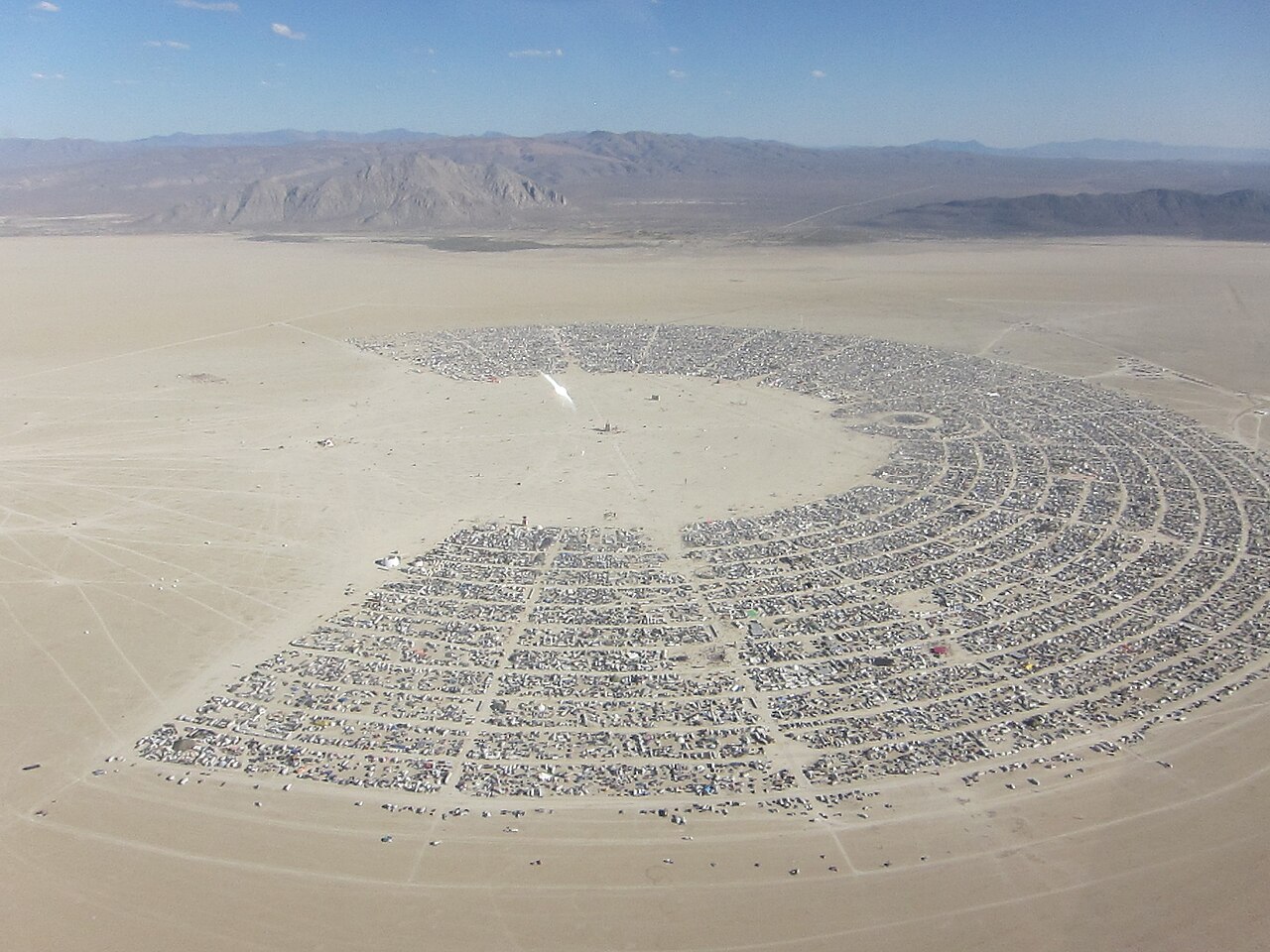
Burning Man's Ten Principles were written by co-founder Larry Harvey in 2004, not as a rulebook handed down from above but as a description of values that had already grown organically out of the event, according to the official text on burningman.org. They are Radical Inclusion, Gifting, Decommodification, Radical Self-reliance, Radical Self-expression, Communal Effort, Civic Responsibility, Leaving No Trace, Participation, and Immediacy. Four of them are doing most of the work in the Frankel debate.
Decommodification
The official language states that the community "seeks to create social environments that are unmediated by commercial sponsorships, transactions, or advertising." Practically, this is why there is almost no cash economy inside Black Rock City. You can't buy a drink, a t-shirt, or a favor from another camp. Everything is meant to be gifted, bartered, or made, and Burning Man itself has spent years actively trying to eliminate what it calls "convenience camping," the practice of paying an outside company to fly you in and hand you a fully built camp. Burning Man's own project page on the subject states plainly that this kind of setup "is not permitted in BRC, and runs totally counter to the values of our community," and ties the objection directly to decommodification, radical self-reliance, communal effort, and participation, per Burning Man's own policy page.
Radical Self-Reliance
This principle "encourages the individual to discover, exercise and rely on their inner resources," in the organization's own words. It's the philosophical basis for why burners are expected to bring their own water, shelter, food, and shade rather than depend on paid services once inside the gates.
Communal Effort and Participation
Communal Effort asks participants to "produce, promote and protect" the shared spaces and social fabric of the city, while Participation states that "transformative change can occur only through the medium of deeply personal participation." Both principles frame Burning Man as something you build with other people, not something built for you to consume.
Why Are Veteran Burners Upset With Bethenny Frankel Specifically?
The specific complaint isn't that Frankel attended, or even that she enjoyed comfort. It's the combination of a fully appointed, camera-ready RV and a vlog structured like a brand campaign. Commenters on her posts argued the version of camping she showed off resembled the "plug and play" model Burning Man has spent over a decade trying to phase out, and that turning the week into a wardrobe-change content series ran against the spirit of decommodification even if no literal cash changed hands on the playa. As Jezebel put it in its coverage, Frankel was "vlogging, fit-checking, and glamping all over la playa," a description meant as a pointed contrast with an event that was supposed to be, as the outlet noted, "an escape from the capitalist hellscape." Reality Tea's write-up on the trip framed the same tension as a live question, asking whether the experience might actually change her rather than the other way around, in a piece titled "Can Burning Man Change Bethenny Frankel?" Some Instagram commenters went further, calling her presence "the anti-Burning Man" or simply writing "that's not the point." Frankel's private RV bathroom sits at the opposite end of the comfort spectrum from the shared portable toilets that one Black Rock City artist has spent roughly a decade turning into decorated porta-sanctuaries.
It's worth being precise here: Burning Man's official "convenience camping" ban targets paid, staffed, fully pre-built operations, not every RV or every camera. Frankel's setup, decorated as it was, hasn't been shown to involve hired staff serving her inside the fence in the way the policy specifically addresses. The criticism she drew is less about a rules violation in the technical sense and more about optics that read, to a lot of longtime attendees, as exactly the spectator culture the policy was written to push back against.
Is Documenting Burning Man Actually Against the Rules?
No, and this is where the fairer version of the argument lives. Radical Self-expression is itself one of the Ten Principles, and Burning Man has never treated documentation as inherently hostile to its values. The event has its own official photographers, live-streams the burning of the Man itself, and runs a public journal at journal.burningman.org that has published decades of first-person accounts. Wikipedia's entry on the event notes that NPR was already describing Burning Man in 2019 as a "destination for social media influencers, celebrities and the Silicon Valley elite," a shift that predates Frankel by years, according to Wikipedia's summary of that coverage. Paris Hilton, Diplo, and various tech founders have all made headlines for their own playa appearances over the past decade, and the event has kept growing rather than collapsing under the attention.
The counter-argument critics of Frankel tend to underweight is that new attendees bringing outside audiences in has functionally always been part of how Burning Man reaches new people, particularly now that there is no official Burning Man livestream or webcam feed for outsiders to watch. A first-timer sharing genuine excitement isn't automatically commodifying the experience, and plenty of burners post extensively about their own camps every year without drawing this kind of backlash. What seems to separate Frankel's case, fairly or not, is scale and polish: a documented history as a professional brand-builder made the RV tour read to critics less like a personal souvenir and more like content strategy applied to a space explicitly built to resist that logic.
Does This Tension Sound Familiar?
It should, because it's the same fault line running through a lot of underground culture right now. We wrote recently about how Boiler Room's sale to a KKR-backed conglomerate forced a platform built on scrappy, artist-first credibility to answer for who actually profits when its name shows up in a new city. Burning Man's Frankel moment is smaller and less structural since no money or ownership changed hands, but the underlying question is the same one: what happens to a culture explicitly organized around resisting commercial logic when the outside world's attention economy shows up anyway. If you're new to the event entirely and want the non-tabloid version of what Black Rock City actually is and how it runs, our companion piece, What Is Burning Man, Actually? A No-Nonsense Guide to Black Rock City in 2026, lays out the mechanics without the vlog gloss.
RTS.FM has run on a version of this same bet since 2006. We're artist-run, non-commercial, and we've never taken outside investment or sold sponsorship space on the stream, partly because we think a scene loses something real the moment its attention gets treated as inventory. If that's a philosophy you want to actually hear rather than just read about, the RTS.FM stream runs live around the clock with no ad breaks, our full catalog sits on Bandcamp with money going directly to the artists, and we post new sets and releases on Telegram as they drop.
quick wins
- Bethenny Frankel flew into Burning Man 2026 via the Burner Express and called it "my version of wrapping myself in bubble wrap for Burning Man."
- Her camp was a pink-themed RV with neon signage, a furnished kitchen, and a full bed and bathroom, toured extensively on video.
- Burning Man's official Ten Principles include Decommodification, Radical Self-reliance, Communal Effort, and Participation, all cited by critics, per burningman.org.
- Burning Man's own policy explicitly states that "convenience camping" (paid, fully pre-built turnkey camps) "is not permitted in BRC," per Burning Man's project page.
- Jezebel and Reality Tea both covered the backlash, with Jezebel describing Frankel as "vlogging, fit-checking, and glamping all over la playa."
- Celebrity and influencer attendance at Burning Man predates Frankel by years; NPR was already describing the event as a draw for "social media influencers, celebrities and the Silicon Valley elite" back in 2019.
Frequently Asked Questions
Did Bethenny Frankel break Burning Man's rules?
Not in a documented, technical sense. Burning Man's ban on "convenience camping" targets paid, staffed, fully pre-built turnkey operations, and there's no public evidence Frankel's RV involved hired on-site staff of that kind. The criticism she received was about spirit and optics, not a confirmed rules violation.
What is Burning Man's decommodification principle?
Decommodification is one of Burning Man's Ten Principles, and it states that the community "seeks to create social environments that are unmediated by commercial sponsorships, transactions, or advertising." In practice, it's why there's almost no cash economy inside Black Rock City and why the event actively discourages paid, pre-packaged camping experiences.
Is documenting Burning Man on social media against the principles?
No. Radical Self-expression is itself one of the Ten Principles, and Burning Man runs its own official photography, live-streams, and journal. Personal documentation isn't inherently at odds with the event's values; the debate around Frankel centered on the volume, polish, and brand-style framing of her content rather than the act of filming itself.
Has Burning Man dealt with celebrity attendance before?
Yes, extensively. Figures including Paris Hilton and Diplo have attended and been covered in the press for years, and NPR was already reporting on Burning Man's shift toward influencer and celebrity culture back in 2019. Frankel's coverage is a continuation of a trend, not a new phenomenon.
Why does this matter to underground music and club culture?
It's a version of a tension that shows up across underground scenes: what happens to a culture built around resisting commercial and spectator logic once mainstream attention and monetized personal branding show up at scale. It's the same question we explored around Boiler Room's private equity ownership, just playing out through a festival's founding principles instead of a corporate sale.