02 SEPT 2026 · rts.fm editorial
The Man Who Turns Desert Toilets Into Tiny Temples
At Burning Man, even the porta-potties get a theme, a scent, and a soundtrack. Meet the DIY ethos hiding behind the door marked 'occupied.'
Every subculture has its own idea of what counts as a canvas. Graffiti writers see a blank wall. Modular synth heads see an empty rack. And at Burning Man, apparently, at least one person sees a plastic portable toilet baking in the Nevada sun and thinks: disco.
That person is Craig Martin, known on the playa by his adopted name "Clem." For roughly a decade, Martin has been turning the least glamorous structures at Black Rock City into what he calls "porta-sanctuaries," fully themed, fully immersive bathroom experiences that briefly transport you out of the desert and into, say, the South Pacific, a Christmas cabin, or a Studio 54 fever dream. It's a story that sounds like a punchline until you actually sit with it, because it turns out to be one of the purest, funniest, and most quietly moving expressions of what Burning Man claims to be about.
Who Is Craig Martin, and Why Does He Decorate Toilets?
Craig Martin runs Cafe 50's, a retro diner in Los Angeles, where by his own account he has always taken an unusual amount of pride in making the restrooms a pleasant place to be. According to SFGate's reporting on Burning Man's decorated toilets, Martin attended his first burn in 2013 and was struck by a single portable toilet someone had adorned with flowers and air freshener, a tiny, unnecessary gift buried inside an otherwise utilitarian structure. He decided to pay it forward, and starting in 2014 he began elaborately decorating multiple units every year he's attended since.
He doesn't just tape up a poster and call it done. Martin picks a specific theme, Christmas, Tiki culture, "Blue Hawaii," Mexico, disco, and then builds out the interior with photographs, informational placards, scents piped in via air fresheners, era-appropriate memorabilia, and trinkets, all scaled to fit inside a space roughly the size of a phone booth. The goal, as he's described it, is to give whoever steps inside "a well-rounded education" on the theme during the sixty-to-ninety seconds they're in there. His Christmas toilet reportedly came complete with stockings, laminated wrapping paper standing in for wallpaper, and roughly 200 holiday songs looping on repeat. One parent apparently told him her kids refused to use any other toilet on the playa for the rest of the week.
The Year of Eight Porta-Sanctuaries
In one particularly ambitious year, Martin decorated eight separate units in a single Burning Man, three of which he considered the standouts: a full Tiki temple, a "Blue Hawaii" retreat, and a Mexico-themed unit. Multiply that by the hours of setup, the props hauled across the desert, and the daily maintenance a dust storm demands, and you start to understand this isn't a bit. It's a genuine seasonal art practice that happens to live inside a toilet.
Why Would Anyone Decorate a Portable Toilet?
Because at Burning Man, the toilet is not exempt from the rules. Everything at the event is, at least in theory, a site for creative expression, and the more mundane the object, the funnier and more pointed the gesture becomes. Martin's work has inspired a wider trend of Burners decorating their nearby units with disco balls, fans, and themed knickknacks, and other campers have since built out their own bathroom concepts around "Purple Rain," pickleball, Jeff Goldblum, "The Love Boat," "I Dream of Jeannie," and Leonardo DiCaprio, according to the same SFGate account. It has become enough of a fixture that Burning Man's own photo archives include a dedicated gallery of bathroom art, a strange and wonderful sentence to type, but an accurate one.
This is also, quietly, a pretty good example of how tightly craft and self-expression are laced through underground creative communities generally, the same instinct that leads a DIY label to hand-paint its own record sleeves or a bedroom producer to build a custom Eurorack patch instead of buying a preset. If you want a longer look at that instinct playing out at the level of an entire industry, we wrote about it in The Independent Labels Are Winning: Inside the 44% Market-Share Shift, which covers why artist-run, non-commercial structures keep outperforming the polished alternative.
What Are Burning Man's 10 Principles, and How Do Decorated Toilets Fit In?
Burning Man operates under a formal set of 10 Principles, written by co-founder Larry Harvey, that function as the event's closest thing to a constitution. Two of them map directly onto the toilet phenomenon.
Radical Self-Expression is defined by the organization as arising "from the unique gifts of the individual," with the explicit note that "no one other than the individual or collaborating group can determine its content." Nobody assigned Craig Martin a Tiki-toilet mandate. Nobody on a committee approved the 200-song Christmas playlist. He simply decided the bathroom needed a theme, and that decision was entirely his to make, which is precisely the point of the principle.
Radical Self-Reliance asks participants to "discover, exercise, and rely on his or her inner resources." Hauling in laminated wallpaper, air freshener rigs, and a full sound loop for a structure you don't own and that a sanitation crew will pump out and move the next morning requires real resourcefulness, not to mention a sense of humor about the odds that your art might get destroyed by dust, wind, or a stranger's poor aim.
Toilets also brush up against Gifting and Immediacy, two of the other principles: Martin's decorations are given freely to total strangers, with no expectation of payment or credit, and they exist entirely in the present tense of that one visit. Nobody photographs the Christmas toilet and takes the actual room home. The gift is the experience itself, and then it's gone.
For a broader primer on how principles like these actually shape daily life in Black Rock City, our companion piece What Is Burning Man, Actually? A No-Nonsense Guide to Black Rock City in 2026 walks through the event's structure for people who've only ever seen the flaming-effigy photos.
How Does Burning Man Actually Handle Sanitation for 70,000+ People?
Behind the jokes is a real logistics operation. According to Burning Man's own infrastructure documentation, portable toilets are distributed in defined zones across Black Rock City, including along the inner ring roughly between C and D streets, an outer ring between G and H streets, dedicated clusters out on the open playa, and expanded banks near the 3:00, 6:00, and 9:00 radial streets where foot traffic concentrates. That placement isn't arbitrary. With a temporary population that has topped nearly 80,000 participants in peak years, toilets have to be close enough to camps and art installations that nobody is sprinting across a quarter mile of open desert at 2 a.m.
Once the event fills up, Burning Man's site states that the units are emptied "around the clock by a fleet of trucks that make a continuous 24/7 circuit." That's not a once-a-day drive-by, it's a rolling, non-stop operation for the full run of the event, because a temporary city that size generates real waste volume, and a single missed rotation would be noticeable fast in 100-degree heat. RVs get their own separate service track, with trucks running roughly 9 a.m. to 9 p.m., identifiable by an amber flashing light and an "RV Only" placard, available for a fee via voucher, with a maximum hose reach of about 30 feet. It's the kind of unglamorous, highly coordinated infrastructure that makes the art possible in the first place, since nobody is doing "radical self-expression" in a bathroom that hasn't been serviced.
It's Bigger Than It Sounds
Sanitation at this scale has apparently been a serious operational line item for Burning Man's Department of Public Works for as long as the event has existed at its current size, going back to when the organization's own historical archives were already discussing porta-potty logistics as a distinct business function in the early 2000s. The scale has only grown since.
What Else Gets Decorated at Burning Man Besides Toilets?
Decorated toilets are the punchline, but they're really just the most absurd data point in a much larger pattern. Burning Man's culture treats almost every object that shows up on the playa as fair game for transformation:
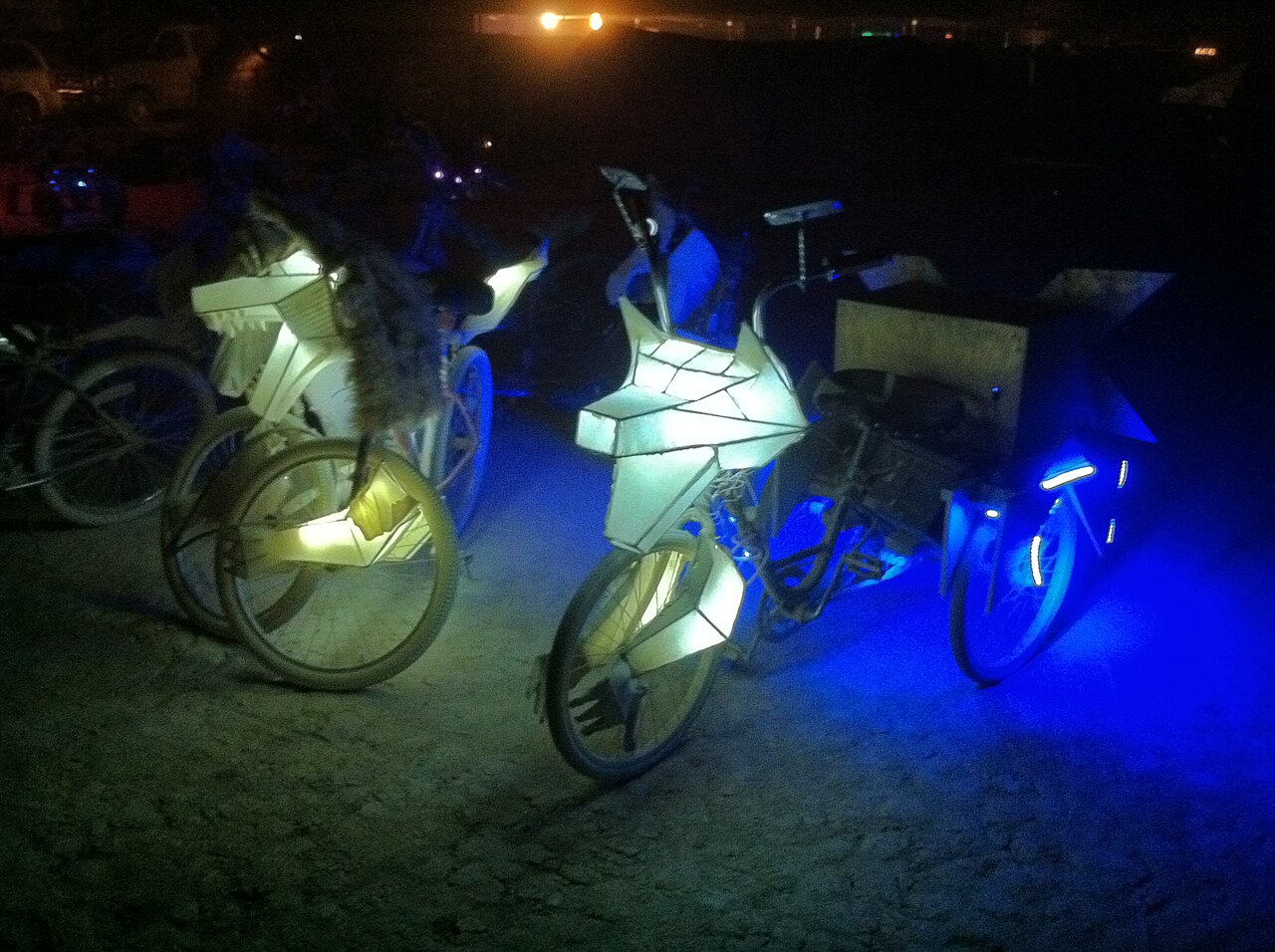
- Bicycles are everywhere in Black Rock City, since it's largely a car-free, pedestrian-and-bike environment, and Burners routinely wrap them in fur, fringe, EL wire, paint, and sculptural add-ons rather than ride them plain.
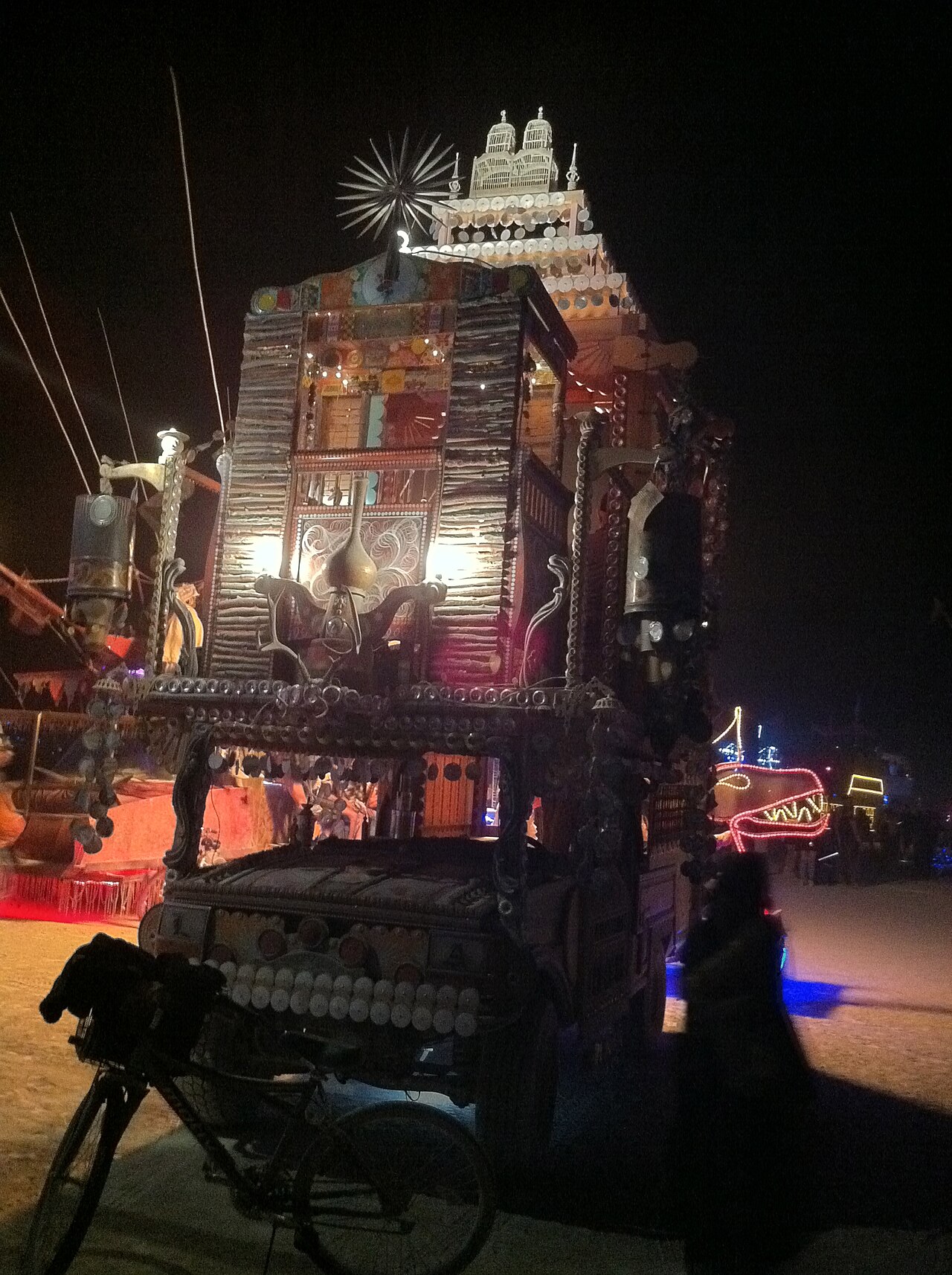
- Art cars, officially called "mutant vehicles," are ordinary trucks and platforms so heavily modified with lighting, sound systems, and sculptural bodies that Burning Man's own vehicle department has to approve them before they're allowed to move; without decoration, they're simply not permitted to drive.
- Generators, shade structures, and camp kitchens, the unglamorous mechanical guts of any camp, regularly get painted, wrapped, or built into larger art pieces so that even the object producing electricity for the block doesn't sit around looking like hardware.
- Costumes and personal dress extend the same logic to the individual: almost nothing is worn "as is."
You can hear a version of this same everything-is-a-canvas energy on wheels and in the air at night, which is the subject of our piece The Real Sound of Black Rock City: Inside Burning Man 2026's Sound Camps and Art Cars, covering the sound systems that turn those decorated vehicles into moving dance floors.
Why This Resonates With Us at RTS.FM
We run an artist-owned, non-commercial radio station and label precisely because we believe the most interesting creative work tends to happen when nobody with a budget or a brand guideline is standing over your shoulder telling you what a thing is "supposed" to be. Craig Martin didn't need permission to build a Tiki temple inside a toilet stall, and none of the producers we release on Bandcamp needed permission to make the tracks they made either. If that DIY, self-determined streak is your thing, our live stream at rts.fm runs on the same basic instinct, and our Telegram channel is where we post about new sets and releases as they happen, no committee required.
quick wins
- Craig Martin, playa name "Clem," has decorated Burning Man portable toilets since 2014 after being inspired by a flower-and-air-freshener toilet he saw at his first burn in 2013.
- Themes have included Christmas, disco, the South Pacific, Tiki, "Blue Hawaii," and Mexico, each decked out with photographs, placards, scents, and memorabilia.
- In one year, Martin decorated eight "porta-sanctuaries" in a single event, with the Tiki, Blue Hawaii, and Mexico units being the most elaborate.
- Other Burners have since built their own themed toilets around Purple Rain, pickleball, Jeff Goldblum, and Leonardo DiCaprio.
- Burning Man's portable toilets are serviced around the clock by a continuous fleet of trucks once the event fills up, per the event's official infrastructure page.
- Burning Man's 10 Principles, especially Radical Self-Expression and Radical Self-Reliance, explicitly protect an individual's right to decide what a piece of self-expression looks like, toilets included.
Frequently Asked Questions
Who decorates the portable toilets at Burning Man?
The best-known figure is Craig Martin, playa name "Clem," a Los Angeles diner owner who has elaborately themed multiple Burning Man toilets every year since 2014. Other individual Burners have since picked up the practice independently, decorating units near their own camps with their own themes.
What themes has the toilet artist used?
Documented themes include Christmas, disco, the South Pacific, Tiki culture, "Blue Hawaii," and Mexico, each filled out with photographs, placards, scent, and era-appropriate props. Other Burners inspired by the trend have added Purple Rain, pickleball, and celebrity-themed units.
How many portable toilets does Burning Man actually use?
Burning Man's official sanitation page describes toilets distributed in zones across Black Rock City's inner and outer rings, plus expanded clusters near major intersections, serviced by a continuous 24/7 fleet of trucks once the event fills up. The organization does not publish a current exact unit count on that page.
Is decorating portable toilets an official Burning Man art project?
No. It's an unofficial, participant-driven tradition, exactly the kind of unsanctioned, individually motivated creativity that Burning Man's Radical Self-Expression principle is written to protect. Nobody applies for a grant to decorate a toilet.
Does this connect to Burning Man's official principles?
Yes. Radical Self-Expression protects an individual's right to decide the content of their own creative act, and Radical Self-Reliance covers the resourcefulness required to actually pull it off in a remote desert with no infrastructure of your own. Gifting and Immediacy are also relevant, since the decorations are given freely and experienced only in the moment.