04 SEPT 2026 · rts.fm editorial · updated 19 SEPT 2026
The Playa Did It Again: Burning Man's Double Shutdown
Wind, dust, then rain shut Black Rock City's gates twice in three days. Here's the geology and logistics behind 'wet playa protocol.'
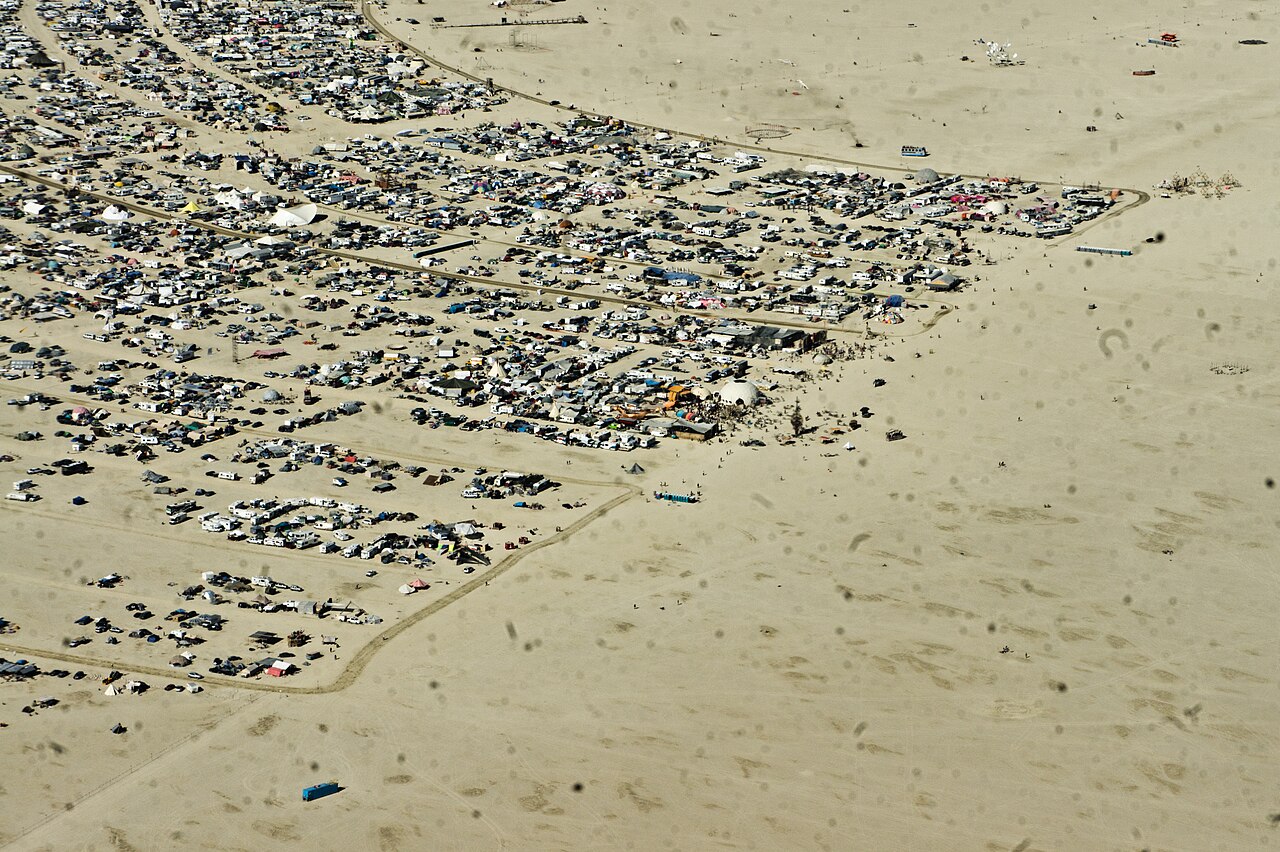
Black Rock City closed its gates twice in the span of about eighteen hours this year, first for wind and dust on Thursday evening, September 3, then for a full day on Friday, September 4, after rain turned the playa into what one attendee called "cement-like mud." Burning Man 2026, themed "Axis Mundi" and drawing more than 70,000 participants to the Nevada desert between August 30 and September 7, has once again been interrupted by the one force its organizers cannot pulse, meter, or route around: weather sitting on top of an ancient lakebed.
For anyone who was in Reno on Saturday morning, checking the BRC Dashboard every twenty minutes and refreshing group chats for word that the gate had reopened, this will read like recent history repeating on a shorter fuse. It is also, underneath the frustration, a genuinely interesting case study in what happens when a 70,000-person temporary city sits on geology that was never built to hold that many vehicles, that much greywater, or that much foot traffic, let alone rain.
What actually happened at the gates this year?
The short version: extreme wind and a dust storm forced Gate to close Thursday evening, September 3. It reopened, then closed again for the entirety of Friday, September 4, after overnight rain saturated the playa surface and organizers activated what's internally known as wet playa protocol, a full ban on vehicle movement both on the playa and on the entry road. Anyone arriving for Saturday's scheduled activities was told, in plain terms, to stay in Reno and wait for an official word that gates were open rather than drive toward Gerlach and risk sitting in a queue with nowhere to go. Coverage from SFGATE's sister outlet the San Francisco Chronicle and SFist both tracked the closures in real time, and SFist also reported that a man in his fifties was found unresponsive on the playa around 6:30 p.m. Thursday and later pronounced dead at the onsite emergency care center. Burning Man Project said he suffered a medical emergency, that no foul play was suspected, and that he had not yet been publicly identified at time of reporting. Black Rock City, with a population comparable to a mid-sized American town for one week a year, typically sees one or two deaths during the event in any given season, a grim but recurring statistical fact of gathering tens of thousands of people in a remote desert with limited emergency infrastructure.
By Friday evening into Saturday, gates reopened, but with reported wait times climbing back above eight hours, on top of the roughly eight-hour queue that had already greeted arrivals on the very first weekend. The Santa Monica Observer documented that opening-weekend jam on August 30 and 31, describing a single access road bottlenecked by the sheer volume of tens of thousands of vehicles converging in a short window, with organizers advising people to arrive overnight or very early morning instead. So this year's story is really two separate strains of the same problem: a road built for a small town absorbing a mid-sized city's worth of traffic, and then, days later, the ground itself turning against every vehicle already inside.
Why does a little rain turn the playa into mud so fast?
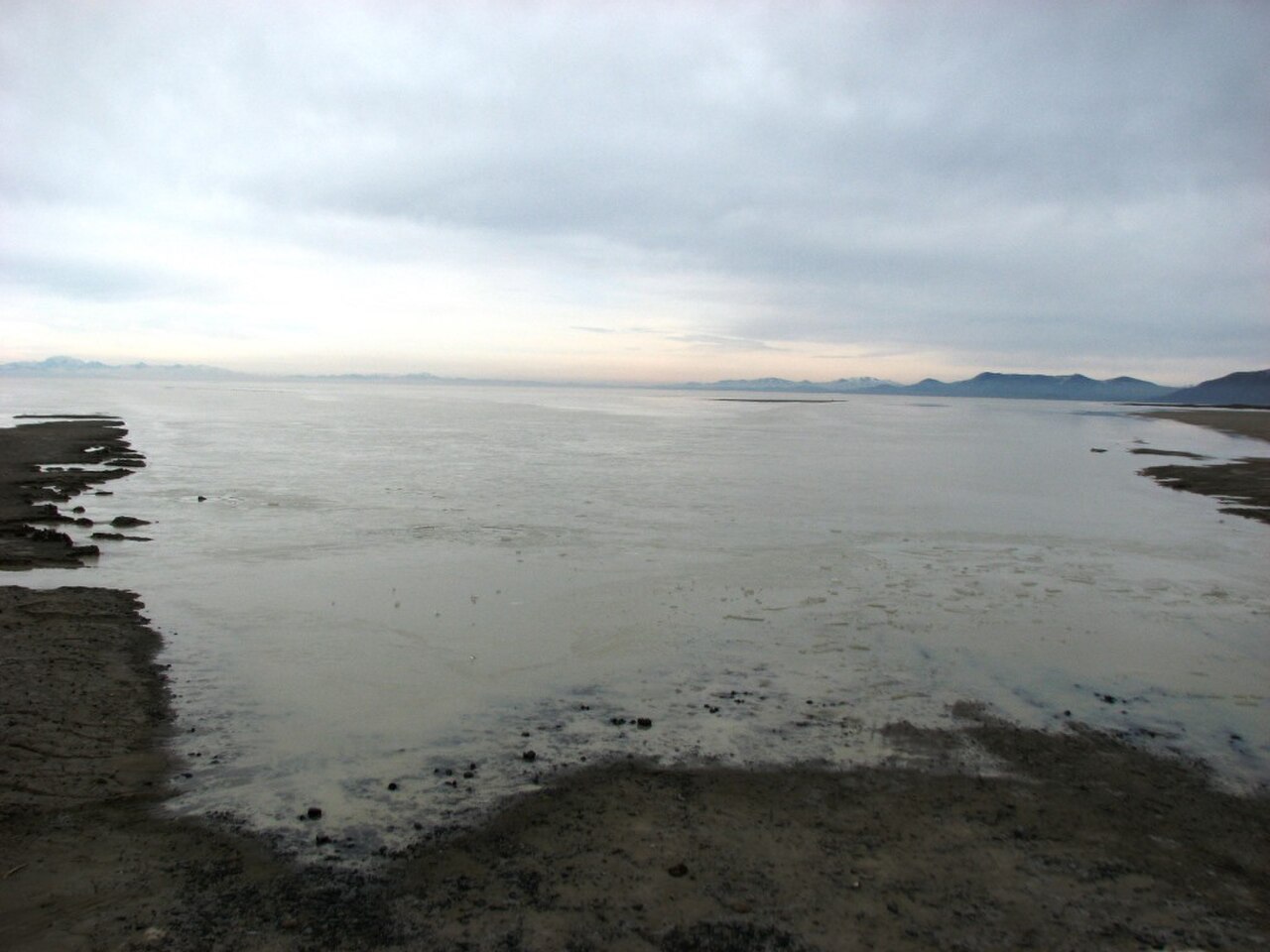
Because the Black Rock Desert isn't really desert soil in the way most people picture it. It's the dried bed of Pleistocene-era Lake Lahontan, an inland sea that covered much of northwestern Nevada roughly 12,000 to 15,000 years ago before the climate warmed and it evaporated, leaving behind a nearly dead-flat basin of fine clay and silt sediment. Weather.com's reporting on the playa's "15,000-year-old issue" lays out the mechanism plainly: that lakebed sediment is expansive clay, meaning it physically swells when it absorbs water, and the basin covers roughly 119 square miles with only about three feet of elevation change across the whole thing. There is nowhere for water to run off to, because the playa is ringed by mountains on essentially every side, a closed hydrological basin with no outlet. Combine clay that swells on contact with water and a bowl with no drain, and you get a surface that goes from rock-hard, cracked, dusty ground to a substance closer to wet concrete within hours of meaningful rainfall.
The numbers make the fragility clear. The area averages roughly six inches of rain a year, and September itself averages only about two-tenths of an inch. Half an inch of rain in a single day, which sounds modest anywhere else, is more than double an entire month's typical allotment landing all at once. There's no gradual saturation process to buffer it. The clay drinks it up, expands, and the top few inches turn into a sticky, adhesive mud that grabs tires, boots, and bike wheels alike and does not let go. It's not "muddy" in the sense of a wet trail; multiple accounts describe it as closer to walking through drying plaster, heavy enough that even four-wheel-drive vehicles get stuck and stay stuck.
What does "wet playa protocol" actually mean?
Wet playa protocol is Burning Man's standing operational response to exactly this scenario, and it is deliberately blunt: no vehicles move, anywhere, on the playa or the entry road, until Black Rock Rangers, the Department of Public Works, and county and federal land managers agree the surface can support traffic again without permanent damage. That's not a suggestion aimed at people's safety alone, though getting a vehicle stuck in setting clay mud is its own hazard. It's also a land management obligation. Black Rock City sits on public land managed by the Bureau of Land Management under a permit that requires the desert surface to be left essentially as it was found. Vehicle tracks pressed into wet clay don't smooth back out when the ground dries; they set into ruts that can persist for months, visible scarring on land the event is contractually required to restore. That's the tension wet playa protocol exists to manage: protecting people from getting stranded in mud, and protecting the playa itself from being reshaped by ten thousand tire tracks that harden in place.
In practice this means everything stops. Art cars, the elaborately mutated vehicles that are normally the only sanctioned way to move quickly across the open playa, are grounded. Supply trucks resupplying camps don't move. The gate itself simply doesn't process incoming or outgoing traffic, because the entry road, Gate Road, is itself playa surface for a meaningful stretch and becomes just as impassable as everywhere else. Burners inside the city are advised to walk or bike only where absolutely necessary, stay off soft or standing-water sections, and treat their camp as a shelter-in-place location until Rangers give an all-clear.
How does 2026 compare to the 2023 flooding disaster?
Meaningfully smaller in scale, though the mechanism is identical. In 2023, the Black Rock Desert received nearly an inch of rain in a 24-hour span starting September 1, an amount equivalent to several months of normal precipitation landing in a single day. That event stranded an estimated 70,000 to 73,000 people for roughly three days, well past the festival's scheduled end. Attendees were told to ration food, water, and fuel; the driving ban held from Saturday through Monday afternoon; and some people, including a handful of recognizable names, ended up hitchhiking out on the backs of pickup trucks once the ban lifted rather than wait for their own vehicles to become mobile again.
2026's closures were shorter and the underlying rainfall lighter (and the Diplo mud meme surfaced again anyway), gates reopened within roughly a day of the Friday shutdown rather than three, but the pattern that produced both events is exactly the same clay-and-closed-basin geology described above. What's notable is the frequency. Between 2023 and 2026, Black Rock City has now dealt with meaningful wet-playa disruption in at least three of four seasons, which is enough repetition that "freak weather event" is starting to look like an annual planning variable rather than an outlier. One attendee's dark joke, calling this year "Mud Burn Season 2," circulated widely enough to make it into coverage, which tells you something about how normalized the risk has become inside the community even as it keeps catching first-timers off guard.
How does Gate and Exodus normally work, when the weather cooperates?
On a dry year, Burning Man's outbound logistics are genuinely impressive engineering for something built from scratch annually and torn down a week later. The official Exodus guide describes a system called pulsing: vehicles move roughly a mile at a time in coordinated bursts along Gate Road, which runs exclusively outbound during Exodus, giving engines rest periods and keeping traffic from fully gridlocking even under heavy volume. Peak departure load hits Sunday night through Monday, when total travel time from the Greeters station near center camp out to pavement on County Road 34 can run six to nine hours, before drivers even reach Reno. F Lot serves as a staging and reunification point along the way, with basic vehicle repair and lockout assistance available through Playa Info and Black Rock Rangers.
For real-time updates during both entry and exit, the event relies on two low-power FM stations built specifically for this: GARS 95.1 FM and BMIR 94.5 FM broadcast travel times and gate status multiple times an hour, information that becomes essential the moment digital signal degrades on the drive in from Reno. The BRC Dashboard mirrors much of that data online for people checking from outside the event entirely, including the friends, partners, and camp mates stuck refreshing a browser tab in Reno hotel rooms during exactly the kind of closure 2026 produced twice. For a plainer breakdown of what the dashboard does and doesn't show, see our explainer on why you can't really watch Burning Man online.
None of that infrastructure is built to handle a full stop, though, which is precisely what wet playa protocol imposes. Pulsing assumes the road is drivable. When it isn't, the entire system simply pauses, and the only real update anyone can offer is "not yet."
Why does this keep happening, and is Burning Man's location the actual problem?
The playa was chosen for size and isolation, not resilience to rain, and that tradeoff is baked permanently into the event's geography. There is no version of siting a 70,000-person temporary city in the middle of Lake Lahontan's old bed that removes the risk of expansive clay turning to mud in a wet year; the same qualities that make the ground perfect for the burn (flat, hard-packed, empty for miles) are downstream of the same lakebed chemistry that makes it treacherous the moment it rains. Organizers can add drainage awareness to permit conditions, invest in better forecasting, and communicate closures faster than they did in 2023, all of which appear to have happened this year given how much shorter the 2026 disruption was. What they can't do is engineer around a closed desert basin's fundamental hydrology. This is less a Burning Man management failure than a recurring collision between a non-negotiable landscape and an event that keeps growing around it, a dynamic not unlike what's playing out with licensing and infrastructure pressure on nightlife venues elsewhere, as we wrote about in our look at the UK's disappearing nightclubs and the regulatory reforms meant to slow the bleeding. Different pressure, same underlying lesson: the physical and regulatory conditions a gathering depends on rarely bend to the gathering's ambitions.
If you want the fuller context on what Black Rock City actually is and why it draws this scale of crowd into a location this hostile in the first place, our companion piece, What Is Burning Man, Actually? A No-Nonsense Guide to Black Rock City in 2026, walks through the event's structure, principles, and logistics for anyone arriving with more questions than answers. And for more on what happened with the death reported during this year's closures, see our separate report on what organizers actually said.
quick wins
- Black Rock City's gates closed twice in 2026: Thursday evening, September 3 for wind and a dust storm, then all day Friday, September 4 for rain and wet playa protocol.
- The Black Rock Desert playa is the dried bed of ancient Lake Lahontan, roughly 12,000 to 15,000 years old, made of expansive clay that swells and turns to sticky mud when wet.
- The basin has almost no drainage: it's ringed by mountains and spans about 119 square miles with only around three feet of total elevation change.
- Wet playa protocol bans all vehicle movement on the playa and entry road until Rangers and land managers confirm the surface can handle traffic without permanent rutting.
- 2023's flooding disaster involved nearly an inch of rain in 24 hours and stranded an estimated 70,000 to 73,000 people for roughly three days; 2026's closures were shorter but driven by the same geology.
- GARS 95.1 FM, BMIR 94.5 FM, and the BRC Dashboard are the three official channels for real-time gate and Exodus traffic updates.
Frequently Asked Questions
Why did Burning Man 2026's gates close twice?
Gates closed Thursday evening, September 3, 2026 because of extreme wind and a dust storm, then closed again for all of Friday, September 4 after overnight rain triggered wet playa protocol, a full vehicle movement ban meant to prevent people from getting stuck and to protect the desert surface from permanent damage.
What is wet playa protocol?
It's Burning Man's standard response to rain saturating the Black Rock Desert's clay surface: no vehicles move on the playa or entry road until Black Rock Rangers and land managers confirm the ground can support traffic again without leaving lasting ruts in land the event is required to restore.
Why does the playa turn to mud so easily?
The playa is the dried bed of ancient Lake Lahontan, made of expansive clay sediment that physically swells when wet. The surrounding basin is ringed by mountains with almost no drainage and barely any elevation change, so rain has nowhere to go and the clay stays saturated and sticky far longer than ordinary desert soil would.
How does 2026 compare to Burning Man 2023's flooding?
2023 was more severe: nearly an inch of rain in 24 hours stranded an estimated 70,000 to 73,000 people for about three days. 2026's closures, while triggered by the same geology, were shorter, with gates reopening within roughly a day of the Friday shutdown.
How do I get real-time updates on gate or Exodus status?
Tune to GARS 95.1 FM or BMIR 94.5 FM, both low-power stations built specifically to broadcast travel times and gate status during the event, or check the BRC Dashboard online, which mirrors much of the same information for people tracking conditions from outside Black Rock City.
If the desert's mood swings have you craving something steadier, RTS.FM keeps streaming from the studio regardless of what the playa is doing, and our back catalogue is always up on Bandcamp. Drop into our Telegram if you were out there this year and have your own gate-closure story worth comparing notes on.