01 SEPT 2026 · rts.fm editorial · updated 19 SEPT 2026
Nobody Books Burning Man's Real Lineup
Burning Man 2026's electronic music scene runs entirely on camp-booked flyers, not festival lineups. Here's who's actually playing Black Rock City.
There is no Burning Man 2026 lineup poster. No festival app pushing set-time alerts, no headliner announced eight months out, no agency press release. And yet, across the seven nights of Black Rock City's 40th anniversary edition, some of house and techno's biggest names, Danny Tenaglia, John Summit, Diplo, Major Lazer, Alok, Monolink, Infected Mushroom, ANNA and Carlita among them, are playing to tens of thousands of people on the open desert floor. Nobody hired them in the way a festival hires a headliner. Camps did.
That distinction is the actual story of electronic music at Burning Man, and it gets flattened every year by coverage that treats the event like a music festival with a strange ticketing system. It isn't one. Burning Man 2026, themed "Axis Mundi" and running August 30 through September 7 in Nevada's Black Rock Desert with an expected 70,000-plus participants, has no official artist booker, no central stage schedule and no festival organizer signing performance contracts. Every sound camp and every mutant vehicle books its own DJs, on its own budget, using its own volunteer labor, and tells people about it days or hours in advance through flyers, camp radio and word of mouth. The Burning Man Project's own camp directory is explicit that it lists camps that applied for placement, not a curated program the organization stands behind.
How does music actually get booked at Burning Man?
Music at Burning Man is booked camp by camp, not centrally. A sound camp, essentially a group of participants who pool money, labor and gear to build a sound system and a piece of infrastructure on the playa, invites the DJs it wants, usually people already inside its own community of artists, friends and past collaborators. There is no festival-style fee structure. Most DJs play for free or for travel costs, because playing Burning Man has never been a paid gig in the conventional sense, it is a contribution to a camp's gift back to the city. Schedules firm up shockingly late by industry standards; as Sparked Magazine's 2026 sound guide puts it, there is "no conventional official lineup," and the practical advice for anyone trying to plan a night around specific music is to "choose one anchor and let the rest of the night remain adjustable." Flyers get posted at camp, on community Instagram accounts and inside apps like the unofficial Deep Playa set tracker in the 48 hours before a set, sometimes less. A DJ can be swapped, a set time can slide four hours, and the person who insists on planning the way they would for Coachella will have a worse week than the person who wanders.
That structure is why nobody, including Burning Man itself, can hand a journalist a definitive artist list in June. It's also why every "2026 lineup" article circulating online is really a snapshot of camp-announced flyers stitched together, subject to change until the moment the needle drops.
Who are the major sound camps and art cars running the show in 2026?
A handful of names have anchored Black Rock City's nightlife for the better part of a decade, and 2026 is no exception, though this year carries an unusually large shakeup at the top.
Robot Heart remains the camp most identified with the Burning Man sunrise set, a rolling double-decker bus turned sound system that built its reputation on all-night-into-dawn sessions on deep playa. According to reporting compiled by The Best Parties' running 2026 lineup tracker, Robot Heart's camp-announced sets this year include Danny Tenaglia's first-ever Burning Man appearance alongside John Summit on Friday morning, Alok's playa debut performing under his house-and-techno alias Something Else, Major Lazer on Thursday, and Monolink closing out Friday's burn set. Opulent Temple, one of the longest-running dance camps on the playa, has flyers circulating for Infected Mushroom (both a live performance and a DJ set), Vintage Culture, Beltran and Nora En Pure across the week.
Dusty Rhino, the Oakland-based fire-and-bass art car that has run for more than a decade, and White Ocean, known for its elaborate all-white stage production, are both confirmed as returning in 2026, though as of this writing neither camp had published a full set schedule, consistent with how late this scene typically locks in details. One notable absence: DISTRIKT, usually one of the loudest camps on the playa, announced on its own site that it is sitting out 2026 entirely to refocus fundraising and rebuild camp infrastructure after weather damage in recent years, with a planned return in 2027. It is a reminder that even the biggest camps run on volunteer labor and donated funds, not festival-scale sponsorship, and that a bad year of dust storms can sideline a camp as easily as a talent dispute sidelines a festival headliner.
The big story: Mayan Warrior steps off the road
The single biggest shift in 2026's electronic music landscape is the absence of the Mayan Warrior art car, the illuminated bird-of-prey vehicle that has been one of Black Rock City's most recognizable late-night draws for over a decade. As EDM.com reported, the Mexico City-based collective confirmed the mobile vehicle will not roll this year. In its own announcement, the group framed it as evolution rather than retirement: "This year, we embrace that spirit as our journey takes on a new form."
In its place, Mayan Warrior is launching Discosmos, a fixed-location camp at 2:00 & J built around large-scale art installations, live performances and a dedicated sound system, according to coverage from us.ok.com. The move trades the logistical burden of building and driving a heavily engineered mutant vehicle across the playa every night for the chance to put more resources into stationary art and programming, without the mechanical risk that comes with running a multi-ton vehicle in desert conditions for a week straight. Mayan Warrior has not ruled out bringing the art car back in future years, and its non-Burning Man operations, festivals, club nights and other Mexico City projects, continue unaffected. The pause is a useful data point on just how resource-intensive these camps are to run: an art car of Mayan Warrior's scale isn't a DJ booth on wheels, it is closer to touring production infrastructure, rebuilt from scratch by volunteers every single year.
What is ADHz, and why does a 19 Hz sound camp matter?
Tucked at 2:00 & H is ADHz, a camp its own organizers describe as a "sound sanctuary for bass music lovers" built around what they call "bass worship in the lineage of sound system culture," according to ADHz's own site. The technical specs are genuinely unusual even by Black Rock City standards: a hi-fi rig tuned down to an infrasound floor of 19 Hz, driven by roughly 80,000 watts of Powersoft amplification and capable of peaking past 140 decibels. At that frequency, sound stops being purely something you hear and becomes something the body registers physically, a pressure in the chest more than a tone in the ear. ADHz runs a nightly program from 7pm to 6am, with afternoons given over to sound baths, wellness workshops and quieter sanctuary time, explicitly positioning itself as a counterweight to the loudest, most maximalist stretches of the playa's nightlife rather than a competitor to them.
ADHz is a small camp by Black Rock City standards, intentionally so. It matters here because it's the clearest illustration of what the camp model makes possible that a normal festival stage almost never would: a dedicated, single-purpose infrasound environment engineered around a specific psychoacoustic experience, built and run by the same people who use it, with no promoter deciding it isn't commercially viable.
What are the notable mutant vehicles at Burning Man 2026?
Music at Burning Man doesn't only happen at fixed camps, it moves. The event's "mutant vehicles," heavily modified art cars licensed by the Department of Mutant Vehicles (Burning Man's own in-house registration process), carry sound systems across the playa and act as mobile stages. Two of the most talked-about new builds for 2026, per reporting from Deep Tech Magazine and Forbes, both come out of Mexico.
TRION, built by Mexico City's FOMO team, is a geometric moving temple constructed around triangle symbolism meant to represent balance, ascension and connection. By day it reads as sacred-geometry sculpture; by night it becomes a full mobile stage, wired for electronic music and lit to match. ¡AXOLOTL! The Earth Guardian, built by Camp Axolotl out of San Miguel de Allende, runs nearly 50 feet long and is closer in scale and intent to a moving stage than a traditional decorated vehicle. It's modeled on Mexico's critically endangered axolotl, a species famous for its regenerative abilities, and its builders have framed the vehicle explicitly around ecological vulnerability and resilience, using the platform for music and performance rather than treating those as an afterthought bolted onto a sculpture.
Both vehicles sit alongside returning favorites like the fire-breathing mechanical octopus El Pulpo Magnifico and the dragon-shaped Abraxas, which has combined music and performance on the playa since 2006, the same year RTS.FM went on air.
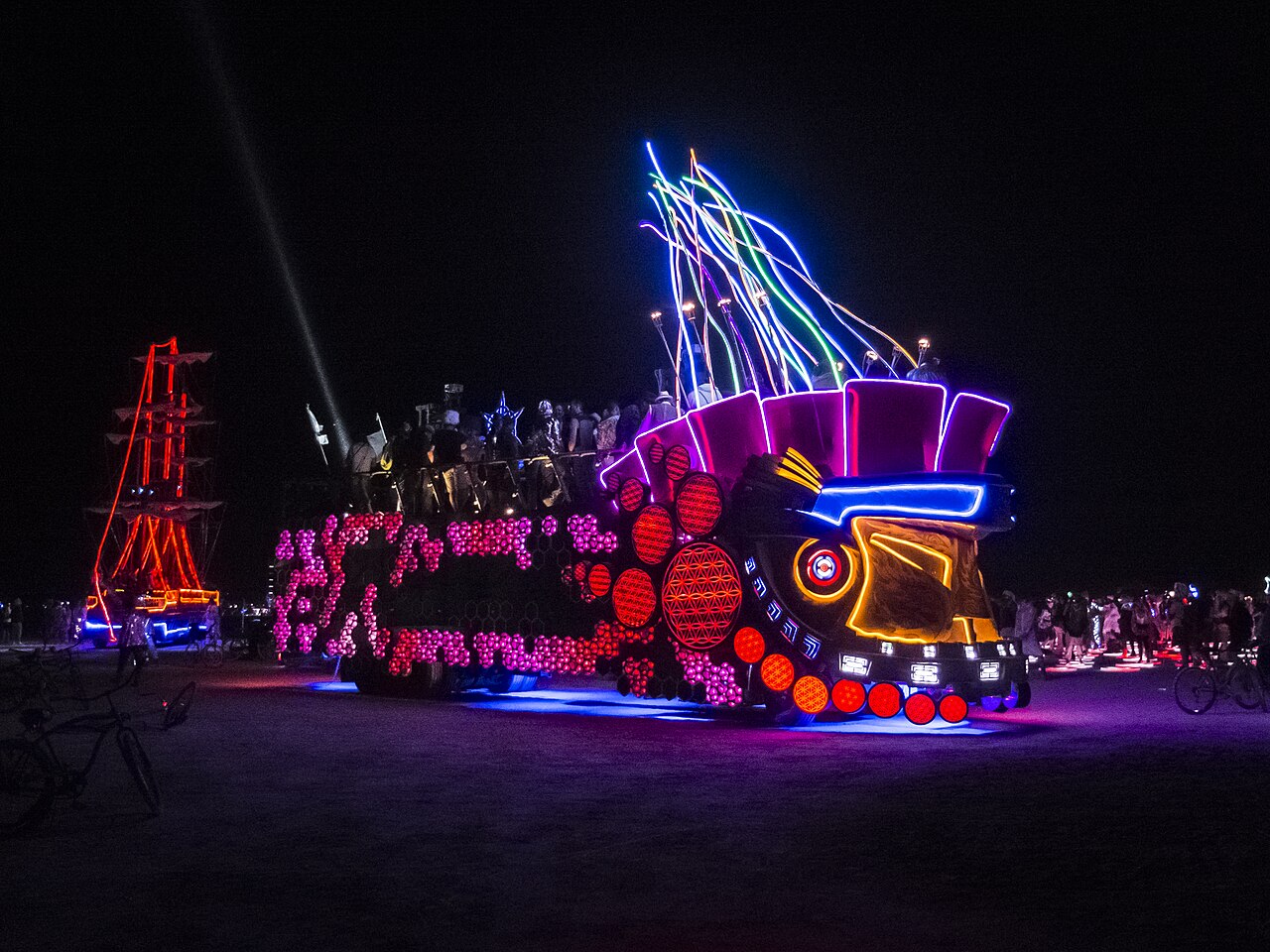
Why does Burning Man's gift-economy booking model matter for electronic music culture?
It would be easy to read all of this as Burning Man simply being a disorganized festival. It isn't a festival at all in the commercial sense, and the difference runs deeper than ticketing. A conventional festival is a business: a promoter buys talent, sells tickets against that talent, and profits or loses money on the gap between the two. Burning Man Project, the nonprofit that organizes the event, sells tickets to fund the city's infrastructure, roads, medical services, the Department of Public Works, but it does not pay a single DJ, and it does not program a single stage. Every sound camp is independently funded, usually through member dues and personal contributions, and every performance is a gift, one of Burning Man's ten stated principles governing the event. Nobody at Robot Heart or ADHz is getting a booking fee wired by a festival ops team. They are burning vacation days and personal savings to build a sound system in the desert so that a stranger can have a transcendent 6 a.m., for free, and then tear the whole thing down without a trace.
That model changes what kind of music gets platformed. A commercial festival books whoever sells tickets, which pushes lineups toward recognizable names and radio-friendly sounds. A camp books whoever its own crew believes in, which is how a niche 19 Hz infrasound sanctuary and a psytrance-leaning act like Infected Mushroom end up coexisting a few blocks apart from a Danny Tenaglia set, with none of them competing for the same slot on the same stage. It's also, not incidentally, closer to how underground dance music actually worked before festivals became the genre's dominant public face, artist-run spaces booking on relationships and taste rather than market data. RTS.FM has run on a version of that same logic since 2006: no ads, no label-approval structure, artists booking artists. Burning Man's sound camps didn't invent that model, but they've kept it running at a scale most underground scenes never get to test.
It's worth saying plainly that this comes with real limits, not just romance. This is the same festival where a $2 million camp compound made headlines for entirely different reasons, and the gift economy has its own well-documented tensions around money, access and who actually gets to build the biggest sound system. But the music side of that tension is specifically what makes camps like ADHz possible: nobody is greenlighting a 19 Hz infrasound room based on ticket-sales projections, because nobody is selling tickets to it.
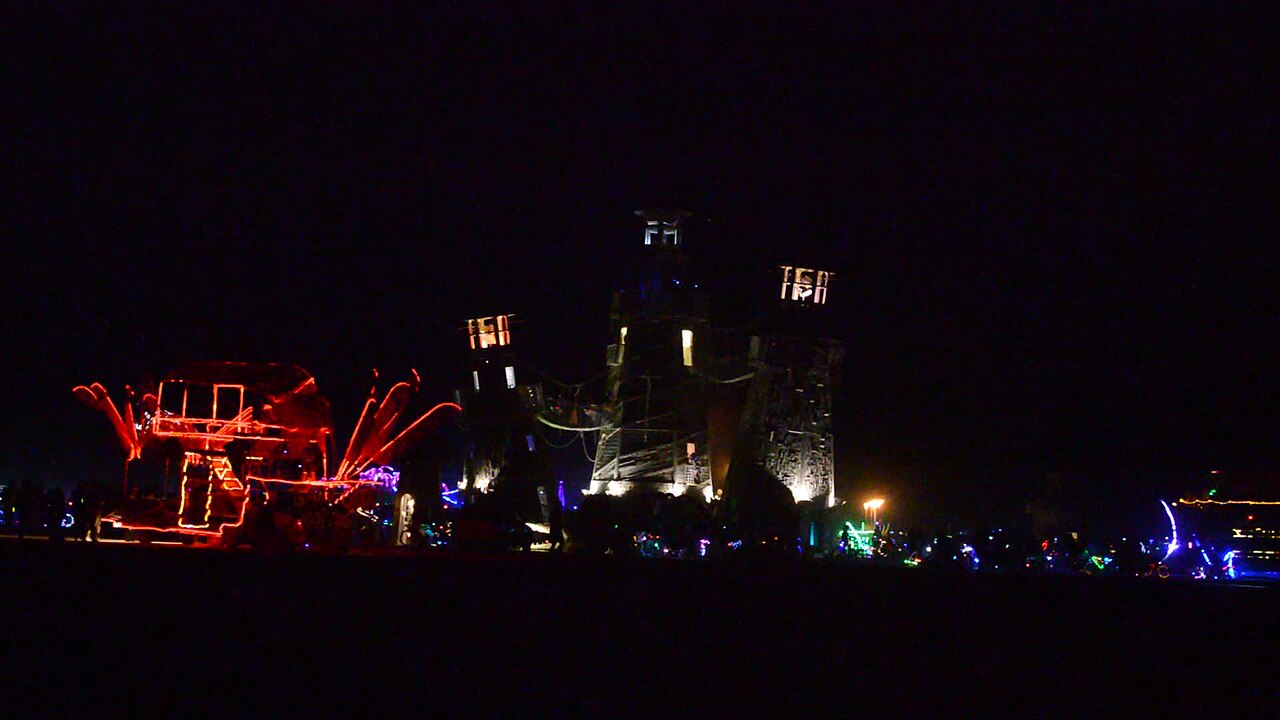
How does this compare to a normal music festival lineup?
At a ticketed festival, an artist's set time, stage size and pay are all negotiated months in advance by agents and promoters, and the schedule is locked and printed. At Burning Man, a DJ might learn their set time the day before, play to a crowd assembled entirely by flyer and rumor, and never see a contract. That informality is also part of why there is no official Burning Man livestream to follow from home. There's also no genre gatekeeping the way a festival curates a "main stage sound." The tempo, mood and crowd at Robot Heart's sunrise slot and ADHz's infrasound sanctuary a few blocks over can be worlds apart, because each camp answers only to its own crew's taste, not a festival brand's identity. That's the same tension RTS.FM covered when hard techno's tempos pushed past 180 BPM and the genre started going mainstream: commercial platforms reward a narrower, louder version of a scene, while camp culture at Burning Man still has room for the extremes on both ends, the barely-audible sub-bass and the marathon 140 BPM techno set alike. It also lines up with the broader trend RTS.FM tracked in its look at why electronic music is now the fastest-growing genre in the US: as dance music's commercial footprint grows, the camp-booked, non-market side of the scene becomes more valuable, not less, precisely because it's one of the few places left where a set gets programmed on taste alone.
quick wins
- Burning Man 2026 runs August 30 to September 7 in Black Rock City, Nevada, themed "Axis Mundi," with 70,000-plus expected participants and zero official festival lineup.
- Music is booked entirely camp-by-camp: sound camps and art cars invite their own DJs and announce via flyers and social posts, usually just days ahead, not through a central festival schedule.
- Mayan Warrior's art car is not appearing in 2026; the collective launched Discosmos, a stationary camp at 2:00 & J built around art installations, live performances and a dedicated sound system.
- ADHz, at 2:00 & H, runs a hi-fi sound sanctuary tuned to 19 Hz infrasound with roughly 80,000 watts of power and 140+ dB peak output, built around frequencies felt as much as heard.
- New 2026 mutant vehicles TRION (FOMO team, Mexico City) and the nearly 50-foot ¡AXOLOTL! (Camp Axolotl) both double as mobile music stages built around symbolic themes, triangle geometry and Mexico's endangered axolotl, respectively.
- DJs whose names surfaced on 2026 camp flyers include Danny Tenaglia, John Summit and Monolink at Robot Heart, and Infected Mushroom at Opulent Temple, alongside Diplo, Major Lazer, Alok, ANNA and Carlita elsewhere on the playa, all unpaid gifts to camps rather than booked festival slots.
Frequently Asked Questions
Does Burning Man officially book DJs or announce a lineup?
No. Burning Man Project, the event's nonprofit organizer, does not book artists or publish a music lineup. Every sound camp and art car books its own DJs independently and announces sets through flyers, camp social media and word of mouth, usually only days before a set happens.
Why isn't the Mayan Warrior art car at Burning Man 2026?
The Mayan Warrior collective chose to pause its mobile art car for 2026 and instead launch Discosmos, a new stationary camp at 2:00 & J focused on art installations, live performances and music programming. The group has described it as a transformation rather than a permanent departure and hasn't ruled out bringing the vehicle back in future years.
What makes ADHz different from other Burning Man sound camps?
ADHz is built specifically around a hi-fi infrasound system tuned to 19 Hz, producing frequencies felt in the body as much as heard, backed by roughly 80,000 watts of amplification and 140-plus decibel peaks. It runs nightly from 7pm to 6am and also hosts afternoon sound baths and wellness programming, positioning itself as a sanctuary rather than a pure dancefloor.
Are DJs like John Summit or Diplo paid to play Burning Man?
Not in the conventional festival sense. Sets at Burning Man camps operate on a gift-economy model: artists typically play for free or for basic costs as a contribution to their camp, rather than under a paid festival booking contract. That's true even for artists with major commercial festival careers elsewhere.
What is a mutant vehicle at Burning Man?
A mutant vehicle is a heavily modified art car licensed through Burning Man's Department of Mutant Vehicles process, often built around a sculptural theme and outfitted with a sound system to function as a mobile stage. TRION and ¡AXOLOTL! are two notable new mutant vehicles for 2026, both incorporating live electronic music into their design.
If this kind of always-changing, artist-run sound culture is the part of Burning Man that actually pulls you in, it's worth remembering it doesn't have to live only on a dusty lakebed one week a year. RTS.FM has been running the same non-commercial, artist-controlled model as an internet radio station and label since 2006, with a live stream at rts.fm, a release catalog on Bandcamp, and a community feed on Telegram for anyone who wants the underground signal without waiting for the playa to reopen. And if you're new to Black Rock City altogether, RTS.FM's companion guide on what Burning Man actually is in 2026 is a good place to start before diving into camp culture this deep.