22 OCT 2026 · rts.fm editorial
Night-Time Licences in England: 14 Years of Home Office Data
Home Office data: licences up 13% since 2011/12, members' clubs down 21%, reviews halved. The growth is shops, not clubs. What it can and can't show.
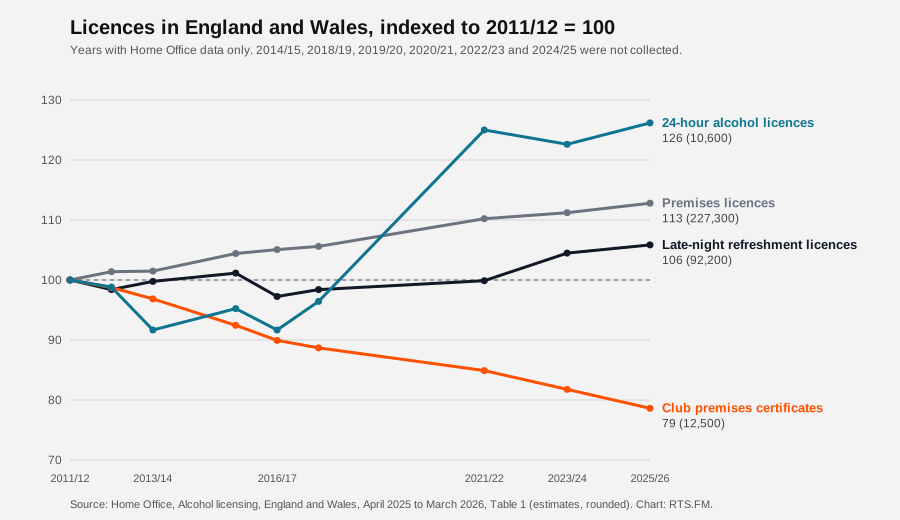
If licensing were what is killing England's nightlife, the official numbers would show it. On 1 October 2026 the Home Office published its annual alcohol licensing statistics for England and Wales, a 15-table dataset that runs back to 2008. We downloaded the tables and read them for the question nightlife keeps asking: are licences, reviews and restrictions closing venues?
The short version: the licensing system is not shrinking. The number of premises licences is up 13% since 2011/12, late-night licences are up 6% and 24-hour licences are up 26%. The growth is in shops, not clubs. Members' clubs are the part that is shrinking, down 21%, and formal reviews of licences have roughly halved since 2011/12 even as they recover from a pandemic-era low. The data cannot show nightclub closures, because it does not count nightclubs as a category.
What the data covers, and its gaps
The Home Office collects the figures from licensing authorities under the Licensing Act 2003. Three limits matter before reading any number:
- The years are not continuous. Data was not collected for the years ending March 2015, 2019, 2021, 2023 and 2025, and not for 2020 because of COVID-19. Our charts and tables use only the years that exist.
- Table 1 is estimated, the rest is reported. The national headline figures in Table 1 include estimates for licensing authorities that did not respond, rounded to the nearest 100. The other tables report counts from responding authorities, so their totals can move with response rates. One London authority, Kensington and Chelsea, had IT problems between November 2025 and June 2026 that affected its 2025/26 data, according to the notes.
- There is no "nightclub" category. Premises are counted by licence type and licensable activity, with a "pubs, bars and nightclubs" bucket only inside the 24-hour licence table.
A licence also generally stays on the register after a venue shuts, until it is surrendered, revoked or lapses, so these counts cannot show closures. They show how much licensing activity exists, not how many rooms are open.
What grew: licences, and the shops behind them
| Measure (England and Wales) | 2011/12 | 2025/26 | Change |
|---|---|---|---|
| Premises licences | 201,500 | 227,300 | +13% |
| Premises licences with late-night refreshment | 87,100 | 92,200 | +6% |
| Premises with 24-hour alcohol licences | 8,400 | 10,600 | +26% |
| Club premises certificates | 15,900 | 12,500 | -21% |
Source: Home Office, Table 1 (estimates, rounded to the nearest 100). Club premises certificates were 17,600 in 2007/08, so the long-run fall is 29%.
The 24-hour figure is where the picture changes. When the licences are split by the type of premises, the growth is mostly in shops.
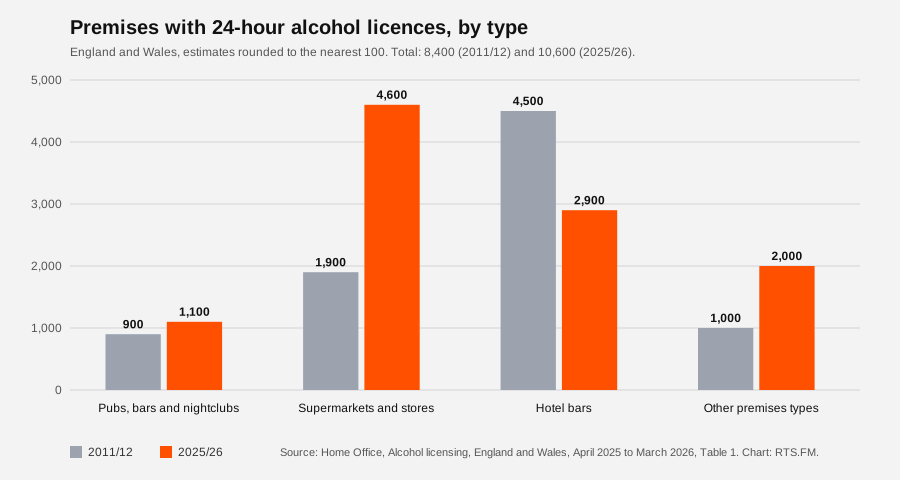
Supermarkets and stores with a 24-hour alcohol licence rose from 1,900 to 4,600. Pubs, bars and nightclubs rose from 900 to 1,100 in the same estimates. Hotel bars fell from 4,500 to 2,900. So the headline "24-hour licences are up" is a story about convenience stores, not about clubs staying open later.
What shrank: members' clubs
Club premises certificates are issued to qualifying members' clubs, such as working men's clubs, sports and social clubs and political clubs, not to commercial nightclubs. They fell from 15,900 in 2011/12 to 12,500 in 2025/26 and were 17,600 in 2007/08. That is a real contraction in a certain kind of social venue, and it is not the same thing as the loss of dance floors.
Enforcement: fewer reviews, more revocations
A licence review is the formal process by which a responsible authority or local resident can ask a licensing committee to attach conditions to a licence, suspend it or revoke it.
| Completed reviews (England and Wales) | 2011/12 | 2021/22 | 2023/24 | 2025/26 |
|---|---|---|---|---|
| Total completed reviews | 1,015 | 347 | 412 | 542 |
| Of which: licence revoked | 186 | 167 | 163 | 250 |
| Of which: licence suspended | 127 | 41 | 49 | 64 |
Source: Home Office, Table 7, authorities' reported counts.
Reviews are down 47% from 2011/12, but up 56% from the 2021/22 low. Revocations rose to 250 in 2025/26, the highest in the series, so the smaller number of reviews is not a sign of softer outcomes. The reasons reported for reviews (Table 8, with more than one reason possible per review) shifted too: crime and disorder cited in 442 reviews in 2025/26 against 646 in 2011/12, public nuisance in 137 against 309, and protection of children in 118 against 292.
Two other enforcement measures are small. Local authorities issued 35 closure notices on premises licences in 2025/26. On spiking, 3 premises had additional conditions imposed in 2025/26 and none had a licence revoked on those grounds, against 9 premises with conditions in 2023/24. The Home Office labels the spiking figures "official statistics in development".
Cumulative impact areas and late-night levies
A cumulative impact area is a zone where a council has evidence that the density of licensed premises is causing problems, which lets it set a tougher test for new licences. The number reported peaked at 223 in 2016/17 and stood at 184 in 2025/26. The number of authorities reporting at least one fell from 107 in 2017/18 to 71 in 2025/26. Brent reports the most, 12, followed by Leeds and Newcastle upon Tyne with 8 each.
Those zones have not stopped new licences. The share of new premises licence applications granted was 83% in cumulative impact areas in both 2012/13 (533 of 645) and 2025/26 (777 of 941), and 91% of all new applications were granted in 2025/26 (9,335 of 10,212), against 92% in 2011/12. The Home Office notes that grants and refusals do not necessarily relate to applications from the same year.
Late-night levies, a charge on late-opening venues that councils can introduce, have stalled. Newcastle was the only authority to introduce one in 2013/14, raising £300,000. Nine authorities were applying one in each of 2021/22, 2023/24 and 2025/26, raising about £2.5 million in the 2025/26 year.
Temporary event notices: the pop-up route is growing
Temporary event notices, which let people hold licensable events at unlicensed premises, rose from 125,217 in 2011/12 to 146,591 in 2025/26, up 17%. Counter notices, which are issued when police or environmental health object, reached 1,220 in 2025/26. That is up 38% from 883 in 2023/24 and close to the 2013/14 high of 1,255. Late notices numbered 29,812 of the 2025/26 total.
For promoters running one-off warehouse or pop-up nights, this is the route that matters, and it is both getting more use and drawing more objections.
What this means
This dataset does not support the idea that licences are vanishing. Quite the opposite: the licensing register is bigger than it was, and where it grew, it grew in shops. Formal reviews are fewer and cumulative impact areas have been retired by many councils. The pressure points the data does show are small: a rise in objections to temporary events and a plateau in late-night levies.
That does not mean venues are safe. It means the loss is not visible in this dataset. The next place to look is property. In our year of planning applications, 33 nightclub premises asked for a new use or demolition, most often housing, and our report on Digbeth's clubs and the Midlands Rail Hub shows a case where the threat is infrastructure. On the legal side, our look at UK nightclub closures and licensing reform covers the policy debate, and the REMEL report shows that the licensing system can still affect some scenes more than others, even when the national totals look steady.
quick wins
- The Home Office published its 2025/26 alcohol licensing statistics on 1 October 2026. Data is missing for the years ending March 2015, 2019, 2020, 2021, 2023 and 2025.
- Premises licences are up 13% since 2011/12 (to 227,300), late-night licences up 6% and 24-hour licences up 26%.
- The 24-hour growth is mostly supermarkets and stores (1,900 to 4,600). Pubs, bars and nightclubs moved from 900 to 1,100.
- Club premises certificates, issued to members' clubs, fell 21% to 12,500.
- Completed reviews fell from 1,015 to 542 but revocations rose to 250. Cumulative impact areas fell from a peak of 223 to 184.
- The data has no "nightclub" category and cannot show closures.
Frequently Asked Questions
How many licensed premises are there in England and Wales?
An estimated 227,300 premises licences as at 31 March 2026, up from 201,500 in 2011/12, according to Home Office Table 1 (estimates, rounded to the nearest 100).
Are nightclubs losing their licences?
The Home Office data cannot say. It does not count nightclubs as a category, and licences generally stay on the register after a venue closes. What it shows is that completed licence reviews have halved since 2011/12 (1,015 to 542) while revocations rose to 250 in 2025/26.
What are 24-hour alcohol licences mostly used for?
Shops. Supermarkets and stores accounted for an estimated 4,600 of the 10,600 premises with 24-hour alcohol licences in 2025/26, up from 1,900 in 2011/12. Pubs, bars and nightclubs accounted for 1,100.
What is a cumulative impact area?
A zone where a licensing authority has evidence that the number or density of licensed premises is undermining the licensing objectives, such as crime and disorder or public nuisance. The number reported across England and Wales was 184 in 2025/26, down from 223 in 2016/17.
How many late-night levies are there?
Nine licensing authorities applied a late-night levy in 2025/26, the same as in 2023/24, raising about £2.5 million in the year, according to Home Office Table 14.
Why is some of the data missing?
To reduce the burden on licensing authorities, the Home Office did not collect data for the years ending March 2015, 2019, 2021, 2023 and 2025, and did not collect it for 2020 because of COVID-19.
Where can I find the data?
On GOV.UK, under "Alcohol licensing, England and Wales, April 2025 to March 2026", published by the Home Office on 1 October 2026. The data tables are available as an ODS file with 15 tables.