12 OCT 2026 · rts.fm editorial
Why Festivals Now Book Hi-Fi Sound Systems Like Despacio
Despacio, Sunflower and ::444:: are billed like headliners. Why promoters sell sound as the attraction, and what that means for dancefloors.
As of October 12, 2026, festivals are booking hi-fi sound systems such as Despacio and Floating Points' Sunflower Sound System because promoters now treat sound quality as an attraction in its own right, one that draws a crowd without a single extra screen or light. Goldenvoice's one-off Head Trip festival (October 10 and 11, 2026, Indio, California) billed Sunflower for its first North American appearance, while Despacio has already appeared on bills at Coachella, III Points and Portola.
What is a hi-fi sound system at a festival?
It is a purpose-built or heavily customised audio rig, usually installed in its own acoustically treated room or tent, that is programmed on the bill the way a stage or an artist would be. The pitch is fidelity and dynamics rather than raw volume: a space where a record can be heard in detail, with DJs chosen as selectors rather than as headline draws.
The idea has moved from the bar to the field. MusicTech's Harry Levin reported on October 7, 2026 that Portola, Coachella, Head Trip and III Points are all emphasising hi-fi spaces inside the festival grounds as a selling point. Goldenvoice's senior vice president of talent, Danny Bell, who books Portola and Head Trip, told the outlet that sound "is number one always." This article uses that feature as a starting point and adds history and context from other sources, including our own coverage.
Who built Despacio, and how?
Despacio was designed by LCD Soundsystem's James Murphy, DFA engineer John Klett and the American amplifier maker McIntosh, with David and Stephen Dewaele of Soulwax and 2manydjs as the other two regular DJs. The Fader's August 2013 interview with the trio described seven 11-foot speakers, a vinyl-only policy and a launch at Manchester International Festival, after an Ibiza party idea that never happened.
According to MusicTech's 2019 profile by Jim Ottewill, the project grew out of conversations between Murphy and Klett after Murphy moved house in 2011. Klett's reference points were the New York clubs of the late 1970s, including the Paradise Garage. McIntosh's UK distributor Jordan Acoustics helped bring the manufacturer on board, and a small company called PBS built the cabinets. Klett said the system was not tested as a whole until about 40 hours before the first doors opened.
The engineering is unusual for a dance system. Each stack is a five-way design with 21-inch drivers for low bass, 15-inch drivers for upper bass and 12-inch drivers for the low mids, plus a large horn. Each stack has 10 kilowatts available, but Klett said the whole system typically runs between 1,500 and 8,000 watts during an event, with no dynamic range control or limiters, so the full range of the vinyl is preserved. Murphy told The Fader that Precious Hall, a club in Hokkaido, Japan, with old speaker boxes sitting on the floor and not flown from the ceiling, convinced him a handmade system could work.
Why did they build it?
The Dewaeles put it plainly in 2013. "Most of the sound systems, they're not really built for the kind of music that we play," Stephen Dewaele told The Fader. Murphy and the Dewaeles wanted a night that put dancing first, a motive Time Out New York repeated when it announced Despacio's March 2018 run at Brooklyn's Knockdown Center, noting the rig weighs around 30 tons and mostly appears at festivals because of transport costs.
Where has Despacio played?
After Manchester, Fact reported in July 2015 that Despacio tents had appeared at Lovebox, Glastonbury and Sónar, with a Roundhouse run in London that September. MusicTech's 2019 profile adds the Southbank Centre's Meltdown and notes that Glastonbury had problems: the tent sat between two other loud stages and the team closed early on the final night. Levin's 2026 feature says Despacio first came to Coachella on April 22, 2016, returned in 2023, and has since landed on lineups at This Ain't No Picnic, III Points and Portola.
It was not originally conceived as a festival attraction. Vice's Thump reported that the system was originally intended for mid-size clubs, not massive festivals. That detail matters for the story that follows.
What is the Sunflower Sound System?
Sunflower is the rig built by Sam Shepherd, the producer and DJ who records as Floating Points. MusicTech reported in April 2025 that it was first teased in 2024 and takes inspiration from other systems Shepherd loves, especially the one at Leeds club night Cosmic Slop, as well as the work of the New York company SBS Slammer. Shepherd worked with designer Carlos Figueroa, known as fig. G. "I need to build the room I want to play in," Shepherd told Apple Music's Tim Sweeney in the interview MusicTech quoted.
Resident Advisor reported on September 7, 2024 that Shepherd would debut the rig at Project House in Leeds the next day, in a fundraiser for MAP Charity, which runs Cosmic Slop. In 2026, MusicTech's Levin wrote that Shepherd has been working on the system for more than a decade and that he and Cosmic Slop co-founder Tom Smith sourced components from around the world to hand-build 14-foot-tall stacks. Levin also reported that Bell and Shepherd, friends from playing Coachella and Portola, discussed a US appearance over dinner in San Francisco in August 2025.
Where has Sunflower been installed?
Beyond Leeds, Groove Atelier reported in July 2025 that the rig made its festival debut at GALA London in May 2025 and then appeared at Glastonbury's Silver Hayes, with eight full stacks confirmed for Dekmantel in Amsterdam on August 1 to 3, 2025. A Resident Advisor film, summarised by Sonic State, described the rig as growing in size at each stop and featuring mycelium acoustic panels.
What happened at Head Trip?
Head Trip took place on October 10 and 11, 2026 at the Empire Polo Club in Indio, the Coachella site. Resident Advisor's September 24, 2026 announcement said Sunflower would sit inside an acoustically treated and panelled dome with ten stacks in a ring around the audience, with Avalon Emerson, Ben UFO, Eris Drew and Octo Octa, Four Tet, Mad Professor, Theo Parrish and Floating Points on the bill. Those were billed plans, and we have not found independent coverage of how the sets went.
How do the main systems compare?
| System | Creators | First appearance | Where it has been programmed |
|---|---|---|---|
| Despacio | James Murphy, John Klett, McIntosh; DJs Murphy and the Dewaeles | Manchester International Festival, 2013 | Lovebox, Glastonbury, Sónar, Coachella (2016, 2023), III Points (2023, 2025), Portola |
| Sunflower Sound System | Sam Shepherd (Floating Points), with fig. G; Tom Smith credited in 2026 | Project House, Leeds, September 8, 2024 | GALA London, Glastonbury, Dekmantel (2025), Head Trip (2026) |
| ::444:: (III Points) | III Points, using L-Acoustics | 2024 | Black Room, Mana Wynwood, Miami (returns in 2026) |
| Paradise Garage system | Richard Long and Associates | Opened with the club, January 28, 1978 | Paradise Garage, New York |
The ::444:: row is a different model. Per MusicTech, it is a fixed room within a festival, with an L-Acoustics system of 66 components and three artists playing four hours each, whereas Despacio and Sunflower travel.
Why are promoters booking hi-fi sound systems?
Three reasons come out of the reporting. The first is differentiation. Bell argues that audiences value good sound more than extra production, and that a poor system can ruin a show with enormous production. Booking a recognisable rig lets a promoter sell a room rather than only a name.
The second is that the room is part of the product. Levin reports that Goldenvoice has an in-house team that builds soundproofing walls in any size or shape, because these systems fail in the wrong room. III Points founder David Sinopoli says the Black Room's acoustic treatment makes you "truly hear" what is played, and the festival designed ::444:: after attendees responded to a room where sound was the headliner.
The third is cultural. Sinopoli says a truth his generation can pass on is to stop staring at the DJ and start staring at each other. At Despacio, Murphy and the Dewaeles watch through a small window while a circular lighting rig draws people to the middle, according to Levin.
Is this a new idea?
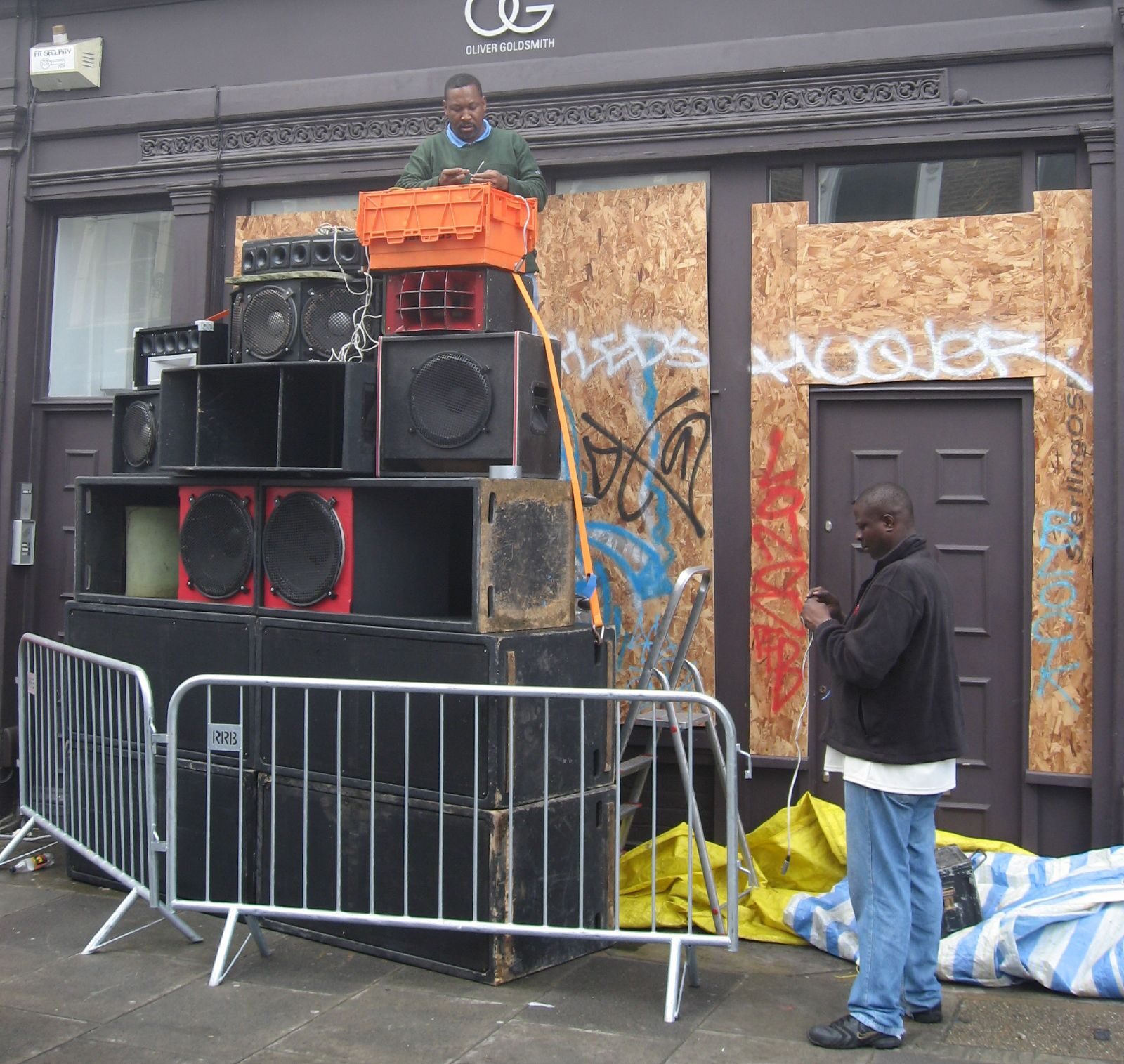
No. The idea is far older than any festival lineup. Wikipedia's history of Jamaican sound systems says the concept took hold in 1940s Kingston, where DJs loaded trucks with generators, turntables and speakers, and by the late 1950s specialists such as Hedley Jones were building custom cabinets. The competition between systems drove innovation, and the culture became central to the Windrush generation in Britain.
In New York, Richard Long designed the custom sound system for the Paradise Garage, which opened on January 28, 1978, according to Wikipedia, and the main room was reportedly designed around it. Klett cited that lineage when designing Despacio, and Shepherd told Apple Music's Beats In Space that Cosmic Slop's system was built with help from New York veterans of the Paradise Garage era.
Clubs have also invested in sound for years. Mixmag reported that Berghain's main room Funktion-One system, installed in 2005, ran for 18 years before an upgrade, and in 2017 Mixmag said Panorama Bar had a new system from Dresden hi-fi company Studio-Akustik. Our guide to the best Berlin clubs in 2026 covers where those rooms stand today. What is new is the festival framing: the system is on the poster.
Does it change how dancefloors work?
According to the people who build them, yes. Klett says the dancers are part of the acoustic treatment, a point he makes with a thought experiment about leather water bags. The Fader's 2013 write-up described Despacio's first night as building slowly, with peaks and troughs rather than one crescendo. At Head Trip, Sunflower's ring of stacks was designed to surround the audience, which changes where people stand and face.
There are limits. The Fader reported that on the first night in Manchester the team had to stay under a 100 decibel limit by law and Murphy used the pause to explain it to the crowd. Glastonbury's sound police and neighbouring stages pushed Despacio to close early once. A hi-fi room at a festival remains a negotiated space.
What we make of it
This section is RTS.FM's own opinion and analysis, not reported fact.
1. Sound over spectacle is a real counter-trend, but not a verdict. Our piece on Sven Väth's "Clowns" comment about Anyma framed a generational argument about visuals and phone-ready DJ sets. Hi-fi rooms are the same argument, expressed by promoters rather than DJs: Bell's argument that audiences value good sound more than extra production is a promoter saying that spectacle has a ceiling. But large-scale visual shows have not gone away: Anyma's Sphere run sold more than 130,000 tickets, according to our earlier reporting. The market is splitting, not choosing.
2. A room that discourages filming is a quiet intervention against phone culture. Despacio puts its DJs behind a small window and its lighting in the centre. That is a design decision about attention, whether or not it was intended as one. Levin's account suggests promoters see it that way. It does not stop anyone from lifting a phone, and we should not overstate it, but the architecture does move the focus away from the booth, which also fits the vinyl-only sets at a time when US vinyl revenue has passed $1 billion for the first time since 1983.
3. Scarcity and economics define who gets to do this. A 30-ton rig, a purpose-built room and a team of builders are expensive. Time Out's 2018 report on Despacio's transport costs and Bell's in-house wall-building team show the cost. Hi-fi sound at festival scale is currently a premium add-on from the largest promoters and a handful of artists with a decade of obsessive work behind them. The risk, in our view, is that "hi-fi" becomes a marketing label with no agreed standard, so audiences should ask what is actually in the room.
4. Underground clubs should read this as validation, not competition. Berghain upgraded its Funktion-One system after 18 years; Cosmic Slop in Leeds is what Shepherd points to when he wants to explain what great sound feels like. Small rooms with careful systems have been the template all along. The festival version borrows their credibility. The fair counter-argument is that a boutique rig inside a stadium-scale event can be a showpiece that does little for the venues that built the culture. The test will be whether the investment returns to small rooms such as those in our Berlin guide, not whether Coachella has another tent.
quick wins
- MusicTech's Harry Levin reported on October 7, 2026 that Portola, Coachella, Head Trip and III Points are promoting hi-fi sound spaces on their lineups.
- Despacio was designed by James Murphy, John Klett and McIntosh, debuted at Manchester International Festival in 2013, and plays vinyl only; it first came to Coachella on April 22, 2016.
- Floating Points' Sunflower Sound System debuted at Project House in Leeds on September 8, 2024 and was billed for its first North American appearance at Head Trip on October 10 and 11, 2026.
- Per Resident Advisor, Sunflower at Head Trip used ten stacks in a ring inside an acoustically treated dome.
- III Points' ::444:: stage uses an L-Acoustics system of 66 components, with three artists playing four hours each.
- Richard Long's custom system for the Paradise Garage, which opened January 28, 1978, is the historical template Despacio's designers cited.
Frequently Asked Questions
What is Despacio?
Despacio is a vinyl-only sound system and club environment designed by James Murphy, John Klett and McIntosh, with David and Stephen Dewaele of Soulwax and 2manydjs as the other DJs. It debuted at Manchester International Festival in 2013.
Who built the Sunflower Sound System?
It was created by Sam Shepherd, who records as Floating Points, working with designer Carlos Figueroa (fig. G). MusicTech reported in 2026 that Cosmic Slop co-founder Tom Smith helped source components for the hand-built stacks.
Where did Sunflower debut?
Sunflower debuted at Project House in Leeds on September 8, 2024, in a fundraiser for MAP Charity, which runs the Cosmic Slop club night. Its festival debut followed at GALA London in May 2025, according to Groove Atelier.
Was Sunflower at Head Trip?
It was billed for Head Trip on October 10 and 11, 2026 at the Empire Polo Club in Indio, California, as its first North American appearance. Resident Advisor announced a lineup including Four Tet, Theo Parrish, Ben UFO and Floating Points.
Which festivals book hi-fi sound systems?
MusicTech named Portola, Coachella, Head Trip and III Points. Despacio has been on lineups at Coachella, This Ain't No Picnic, III Points and Portola, and Sunflower has appeared at GALA, Glastonbury and Dekmantel.
Why are festivals booking hi-fi sound systems now?
Promoters such as Goldenvoice's Danny Bell say audiences value good sound and that it anchors a communal dancefloor. A bespoke room also gives a festival something to promote that is separate from its headliners.
Is a hi-fi sound system the same as a Funktion-One or club rig?
Not necessarily. Hi-fi is a loose label for rigs designed around fidelity and dynamics in a tuned room. Berghain's main room has used Funktion-One since 2005, and Panorama Bar's 2017 system came from Dresden hi-fi firm Studio-Akustik, so the categories overlap.
How powerful is Despacio?
It is often described as a 50,000-watt system with seven stacks, each 11 feet tall. John Klett told MusicTech in 2019 that it typically runs at 1,500 to 8,000 watts overall and uses no limiters.
Where did the idea of the sound system come from?
Wikipedia says the sound system concept became popular in Kingston, Jamaica, in the 1940s. The idea later shaped New York disco clubs such as the Paradise Garage, whose custom system was designed by Richard Long.
Do hi-fi rooms replace big-stage production?
No. The festivals booking them still book large headliners and big stages. The hi-fi rooms sit alongside them as a quieter, communal alternative.