Berlin, Germany · 25-29 AUG 2027
Berlin Atonal
A biennial festival for experimental sound and audiovisual work inside Kraftwerk Berlin's former power plant, tracing back to the West Berlin underground of 1982.
History
Berlin Atonal started in November 1982, staged in the divided, subsidized, culturally isolated West Berlin of the Cold War, where Dimitri Hegemann, later the founder of Tresor club and Tresor Records, built a platform for music that had nowhere else to play. Across five editions between 1982 and 1990, held mostly at the Kreuzberg venue SO36, Atonal booked the acts that West Germany's mainstream circuit had no interest in: Einstürzende Neubauten, Malaria!, Test Dept, Laibach, Psychic TV, Die Haut and an early-era Depeche Mode all appeared, alongside industrial, no wave and experimental acts that were still years from any kind of commercial recognition. It was, by design, a festival for music that did not fit a genre.
The festival stopped after 1990. Hegemann has said the pause was deliberate: with the Wall down and Berlin's underground reorganizing itself around the emerging rave scene, his own attention shifted to opening Tresor, and the cult of the individual performer that Atonal had platformed felt out of step with techno's anonymous, collective energy. Atonal went dormant for 23 years.
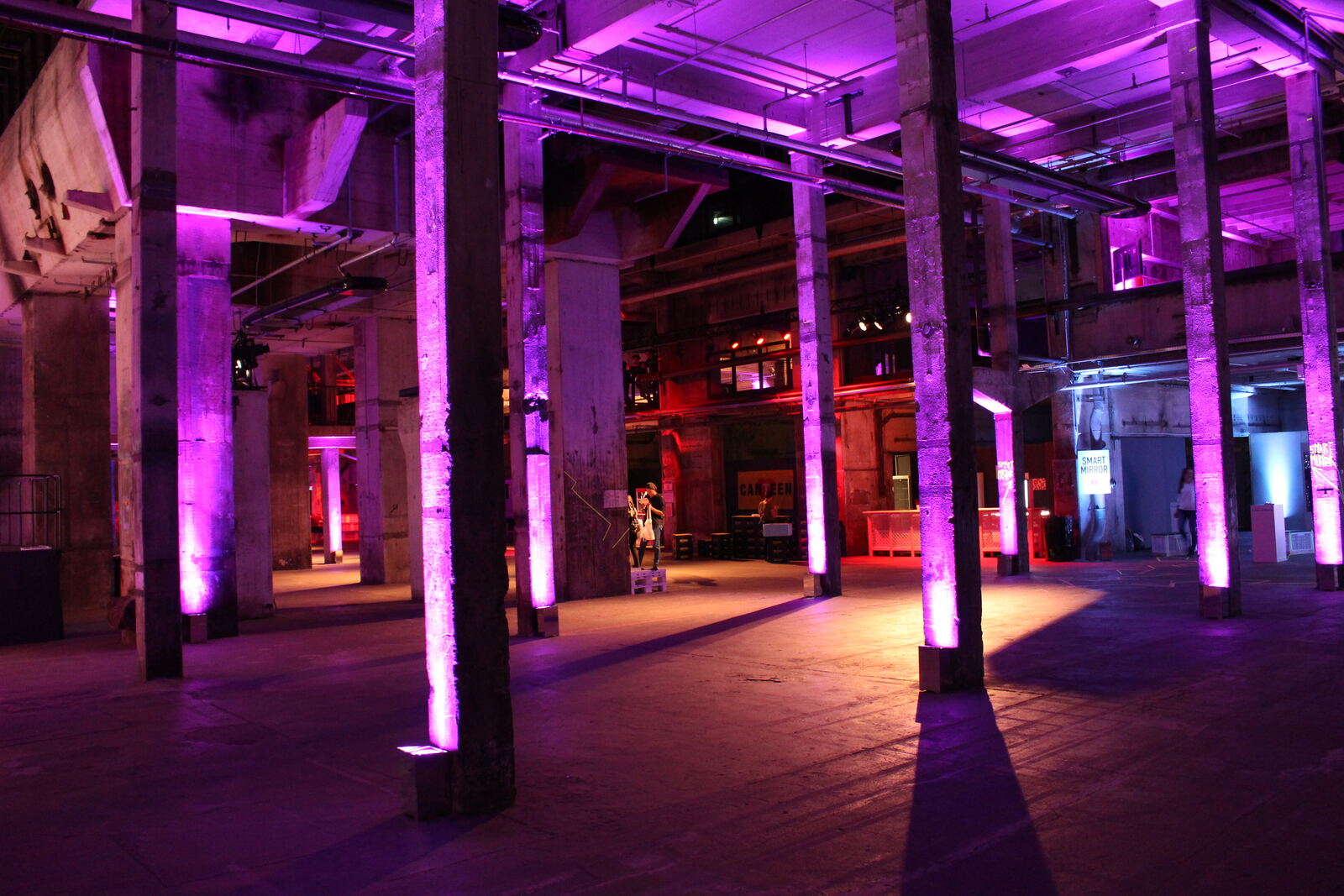
Its home since relaunching is Kraftwerk Berlin, a combined heat and power plant built between 1960 and 1964 on Köpenicker Straße to supply electricity and district heating to Alexanderplatz, the Charité hospital and the GDR's State Council building. The plant was decommissioned in 1997 when a newer facility took over its load, and it sat empty for years before Hegemann began reviving sections of the site in the mid-2000s, first as an extension of Tresor. The raw concrete halls, exposed pipework and turbine floors that make Kraftwerk one of Europe's most distinctive event spaces were never designed to be beautiful; they were built to move heat and power through East Berlin, which is part of why they still feel unlike any purpose-built concert venue.
Atonal returned in 2013, with Hegemann handing day-to-day direction to a younger team, Laurens von Oswald, Harry Glass and Paulo Reachi, who rebuilt the festival inside Kraftwerk's halls as a multi-day program of new commissions, audiovisual premieres and installations rather than a straightforward concert bill. Hegemann's own explanation for stepping back was pointed: he said the new organizers understood the festival's legacy well enough that handing it over was not really a risk.
The relaunched festival moved to a biennial rhythm after 2023, when organizers said the next edition would follow in 2025. That 2025 edition ran 27 to 31 August across Kraftwerk's spaces with new work from artists including Bendik Giske, Amnesia Scanner, Mark Fell and Moin, and it became a formal member of the International Biennial Association, a marker of how far the festival has moved from its scrappy 1980s origins toward recognition as a serious institution for experimental sound and visual art. In between, a one-off 2026 collaboration with Kraków's Unsound, titled The Infinite Now, ran as a 30-hour program at Kraftwerk on 16 and 17 May, with Caterina Barbieri, Kali Malone and Stars Of The Lid among the names.
Techno's more club-facing end has always had a place on the bill. Donato Dozzy appeared with Neel in 2014 and again in 2016 with Lory D for a four-hour hybrid DJ and live show. Surgeon performed in 2018 as one half of the Transcendence Orchestra with Dan Bean, and in 2025 TYGAPAW played the first night while Topdown Dialectic played the closing night.
That combination, a festival born out of Cold War West Berlin's cultural isolation, closed for 23 years, then rebuilt inside a decommissioned power station, gives Atonal a different identity from Berlin's club-centered techno festivals. It sits closer to the tradition of sound art biennials than to a standard techno lineup, even as techno and industrial music remain part of its programming.
festival facts
- Founded: 1982, by Dimitri Hegemann (paused 1990 to 2013)
- Founders/Organizers: Dimitri Hegemann founded the original festival; the 2013 relaunch has been run by Laurens von Oswald, Harry Glass and Paulo Reachi
- Venue: Kraftwerk Berlin (Köpenicker Straße 70, 10179 Berlin), a former combined heat and power plant built 1960-1964, decommissioned in 1997 and revived as a cultural venue in the mid-2000s
- Format: biennial since 2023, multi-day program of new commissions, premieres and installations across the power plant's turbine halls
Getting there and practical info
Berlin Atonal is a one-site festival: the whole program happens inside Kraftwerk Berlin in the city's Mitte district, and the building is shared with Tresor. As of 10 October 2026 the 2027 edition is announced for 25 to 29 August, with the first tickets going on sale in December 2026 and a waiting list open on berlin-atonal.com.
- Address: Kraftwerk Berlin, Köpenicker Straße 70, 10179 Berlin.
- Nearest U-Bahn: The U8 line to Heinrich-Heine-Straße, which Tresor lists as the next subway station at the same address.
- Airport: Berlin's commercial airport is Berlin Brandenburg Airport (BER).
- Age policy: The festival's 2025 information set the minimum age at 18 and warned of high sound pressure levels and strobe lighting. Check the 2027 information before you buy.
- Tickets: Sold directly by Berlin Atonal through berlin-atonal.com. No on-sale date or price has been published for 2027 beyond the December 2026 announcement.
- What sets it apart: The same ticket has historically opened the whole Kraftwerk complex on a given night, with access to individual stages depending on capacity and sometimes involving queues.
FAQ
Does Berlin Atonal happen every year?
No. After the 2023 edition the festival moved to a biennial schedule, with editions in 2025 and 2027 and a one-off 2026 collaboration with Unsound called The Infinite Now.
When is the next Berlin Atonal?
Berlin Atonal '27 is announced for 25 to 29 August 2027 at Kraftwerk Berlin. The first tickets go on sale in December 2026, and a waiting list is open on the festival website.
What kind of music and art does Berlin Atonal book?
The festival focuses on experimental sound, techno and industrial music alongside audiovisual installations and new commissioned works, closer in spirit to a sound art biennial than a conventional club festival lineup.
Is Berlin Atonal connected to Tresor?
Yes. Both trace back to Dimitri Hegemann and share the same building, Kraftwerk Berlin. Hegemann founded Atonal in 1982, later founded Tresor after Atonal's original run ended in 1990, and began reviving the Kraftwerk site as an extension of Tresor in the mid-2000s before Atonal itself relaunched there in 2013.
Where is Berlin Atonal held and how do I get there?
At Kraftwerk Berlin, Köpenicker Straße 70, 10179 Berlin. The nearest subway station is Heinrich-Heine-Straße on the U8 line, and the city's airport is Berlin Brandenburg Airport (BER).
What is the age limit at Berlin Atonal?
At the 2025 edition the minimum age was 18, and the festival warned about high sound pressure and strobe lighting. Check the official information for the 2027 edition before buying.
How do I buy tickets for Berlin Atonal?
Tickets are sold directly by the festival through berlin-atonal.com. The first 2027 tickets are due to go on sale in December 2026, and a waiting list is open now.
Which RTS.FM artists have played Berlin Atonal?
Donato Dozzy played in 2014 and 2016, Surgeon in 2018, and TYGAPAW and Topdown Dialectic in 2025.
RTS.FM artists connected to this festival
Only sourced appearances at past editions or on announced lineups are listed.