12 OCT 2026 · rts.fm editorial
Oxygène at 50: Jarre's Reissue and His ADE 2026 Opener
Jarre's Oxygène turns 50 with a 20 November reissue on BMG and an ADE 2026 opening concert. What's in the box, and why it still matters.
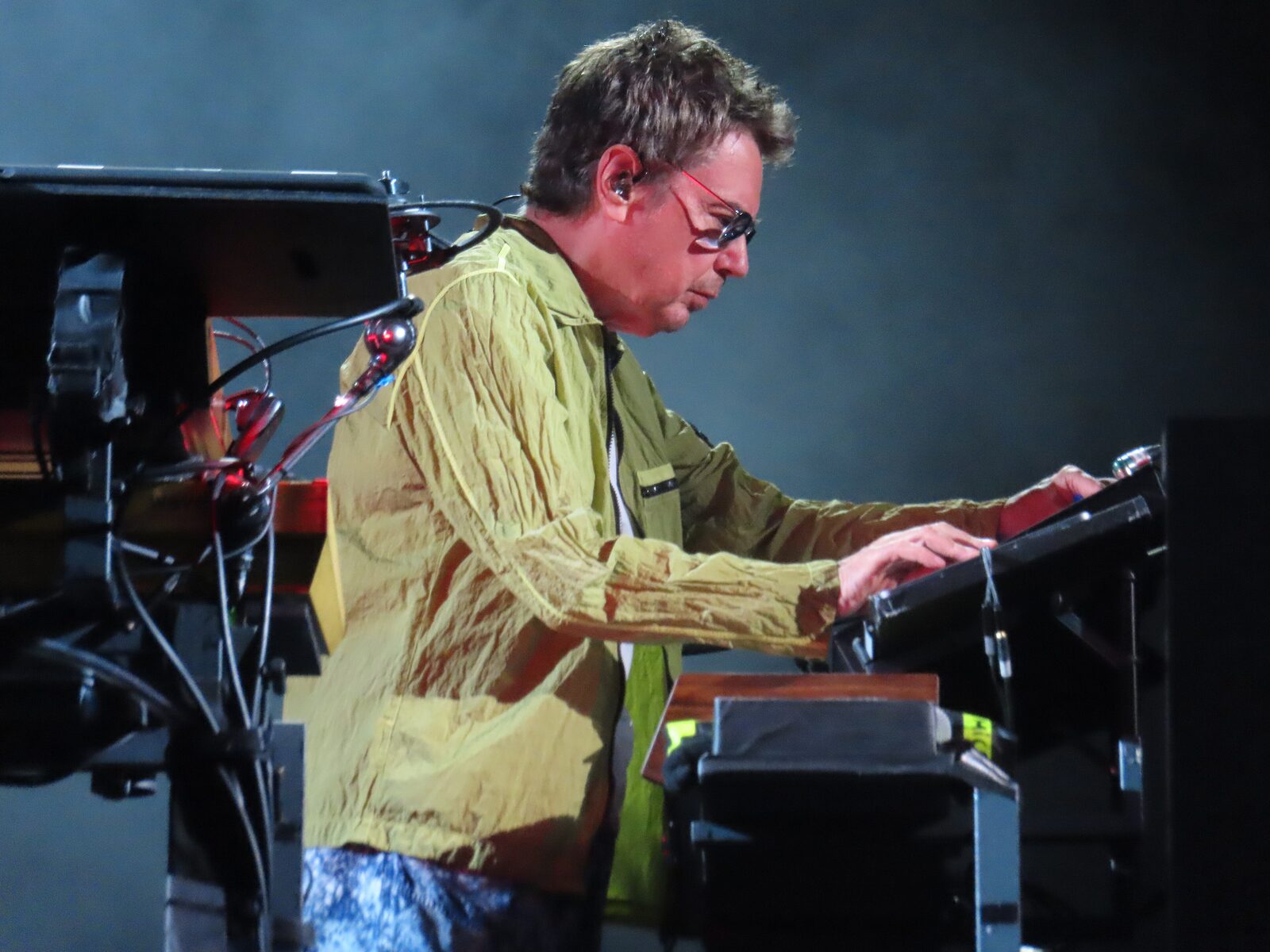
Jean-Michel Jarre's Oxygène turns 50 this year, and the 50th anniversary edition is due on 20 November 2026 through BMG, in a 180g half-speed vinyl cut, a CD, a limited coloured eco-vinyl, digital formats and a Blu-ray mediabook carrying the album's first Dolby Atmos mix. Before that lands, Jarre plays the opening concert of Amsterdam Dance Event on Wednesday, 21 October 2026, at AFAS Live, as the festival's official guest of honour for its 30th edition. The ADE booking was announced earlier; the reissue followed in October. Together they turn a French home-studio record from 1976 into the centrepiece of two very different anniversaries.
This piece sets out what has been confirmed about the reissue and the ADE show, what has not, and where Oxygène actually sits in the story of club and electronic music. We read the announcement coverage and the primary pages we could reach, checked the history against Wikipedia, Qobuz and Dazed, and kept our own opinions in a clearly labelled section near the end.
What is Oxygène?
Oxygène is Jean-Michel Jarre's third studio album, an instrumental, synthesizer-led record in six numbered parts, released in France in December 1976 and internationally in 1977. Wikipedia's entry on the album lists it at 39 minutes and 39 seconds, with Parts I to III on side one and Parts IV to VI on side two. It reached number one in France and number two in the UK, and number 78 on the US Billboard 200, all in 1977.
The headline sales figure is "more than 18 million copies", repeated in the announcement coverage and in the MusicRadar headline. Treat it as an estimate rather than an audited number. Wikipedia gives the same 18 million as an estimate as of 2016, while a Qobuz retrospective cites about 15 million worldwide and 1.8 million in France. Nobody disputes that it is one of the best-selling instrumental electronic albums ever made, only the exact count.
How was Oxygène made?
Jarre recorded Oxygène at home in Paris, mostly between August and November 1976, with an eight-track tape machine, a homemade mixing desk and a small collection of synthesizers. The anniversary announcement says the studio was the former kitchen of his Paris apartment, which is also the origin of the "kitchen" line in MusicRadar's headline.
What gear was on it?
The credit list quoted on Wikipedia names an ARP 2600, an Eminent 310 Unique organ, an EMS Synthi AKS and an EMS VCS 3, plus Mellotron, RMI keyboards, a Korg Mini-Pops 7 drum machine, Revox tape machines and a Scully eight-track recorder. The same page credits Michel Geiss with helping buy, record and programme some of the instruments. We are relying on the album's credits as transcribed there, not on an interview with Jarre, so treat the full gear list as sourced but secondhand.
Why was the label story strange?
Several labels turned the finished record down, Island among them, according to Wikipedia, and Jarre told Qobuz it "was turned down everywhere". It came out on Disques Motors, the small label run by Francis Dreyfus, and Polydor handled international distribution in 1977. That is why the name "Dreyfus" trails the album: the early recordings sat with Francis Dreyfus Music, and Music Business Worldwide reports that BMG bought it in 2012, which gave BMG the recordings of Jarre's first three albums. Disques Dreyfus was also the imprint on the 1997 sequel. So the "Disques Dreyfus Oxygène" most people mean is a later name for the same family tree.
Wikipedia adds one detail we found charming but have not cross-checked elsewhere: it says the first pressing of 50,000 copies went to hi-fi shops to demonstrate stereo. If true, Oxygène was a hi-fi demo disc before it was a pop hit, which fits how festivals now sell sound systems as headliners.
What happened after 1976?
The record was slow to land with critics. Wikipedia's review roundup shows much of the 1977 UK press unmoved, with punk setting the agenda, even as "Oxygène (Part IV)" climbed to number four on the UK singles chart in January 1977. Listeners disagreed with the critics, and the album became a long-seller.
| Date | What happened |
|---|---|
| 24 August 1948 | Jarre is born in Lyon |
| 1969 | Joins the Groupe de Recherches Musicales in Paris, founded by Pierre Schaeffer |
| August to November 1976 | Oxygène is recorded in his Paris home studio |
| December 1976 | Released in France on Disques Motors |
| January 1977 | "Oxygène (Part IV)" reaches number 4 on the UK singles chart |
| 1977 | International release via Polydor; album peaks at number 2 in the UK |
| 14 July 1979 | Free Bastille Day concert at Place de la Concorde, reported at more than 1 million people |
| 27 January 1997 | The Orb release "Toxygene", born as a remix of Oxygène 8 |
| 17 February 1997 | Oxygène 7-13 released on Disques Dreyfus |
| 2 December 2016 | Oxygène 3 released on Sony and Columbia, for the 40th anniversary |
| 17 September 2026 | BMG announces it will license Jarre's recorded catalogue and future work |
| 6 October 2026 | Oxygène 50th anniversary edition announced |
| 21 October 2026 | Opening concert at AFAS Live for ADE's 30th edition |
| 20 November 2026 | Anniversary edition due |
What about the mass concerts?
The Place de la Concorde show on 14 July 1979 was a free Bastille Day concert, and Wikipedia's Jarre article reports more than a million people and a Guinness record for a large outdoor concert. One caveat from Qobuz: that show came about seven months after the follow-up album Équinoxe, so it belongs to the Oxygène era but is not an Oxygène launch. Later city-scale shows followed, including Houston in 1986, London's Docklands in 1988 and Moscow in 1997. Wikipedia lists attendance for those in the millions, but it is inconsistent with itself on some figures, so we would not quote any single crowd number as settled.
Why did the sequels matter?
Oxygène 7-13 arrived on 17 February 1997 on Disques Dreyfus. Per Wikipedia, it used the same synthesizers as the original, was dedicated to Jarre's former mentor Pierre Schaeffer, and peaked at number 11 in the UK. It also pulled Jarre into the club orbit by accident. The Orb's "Toxygene" began as a remix of "Oxygène 8", but Alex Paterson's group took the track apart and kept only fragments. The result reached number four on the UK singles chart in February 1997, according to Wikipedia's page on the single. Jarre later denied reports that he had hated it.
Oxygène 3 followed on 2 December 2016 for the 40th anniversary. Wikipedia's entry says it was recorded in about six weeks and mixed in Ableton Live, with a liner-note instrument list of roughly 40 items that includes the ARP 2600, a Mellotron, a Roland TR-808 and a Teenage Engineering OP-1. It scored 65 on Metacritic, which is polite for mixed. That gear list is a neat bridge to our recent coverage of Teenage Engineering saying it will stop making synthesizers and of Ableton at 25: the 2016 sequel was made with exactly the hardware and software that those two companies sell.
What's in the Oxygène 50th anniversary edition?
The edition is a 2026 remaster made from the original tapes, plus the first Dolby Atmos mix and a new 5.1 mix of the album, due on 20 November 2026 on BMG Records. Here is what the announcement coverage agrees on, as reported by Louder via Yahoo, We Rave You and Synthtopia:
- A 180g black vinyl edition, half-speed mastered and cut by Miles Showell at Abbey Road Studios.
- A CD, a limited coloured eco-vinyl edition and digital editions.
- A deluxe Blu-ray mediabook carrying the Dolby Atmos mix, a new 5.1 mix, the 2026 stereo remaster and selected archival material. One French report describes the archive content as previously unseen photographs.
- The Atmos mix was made by David Kosten, Steven Wilson and Jarre for Distant Swimmer, a new immersive-audio partnership between Kosten and Wilson. Oxygène is its first project.
- New writing in the package. We Rave You lists liner notes by Alexis Petridis, Alma Rota and Torsten Groß, with reflections from Kelly Lee Owens and Solomun. Only that one outlet gave the full list.
Jarre says the remaster went back to the original analogue tapes to preserve their character rather than change it. Jarre's own store page lists five formats: vinyl, colour vinyl, Blu-ray, a 7-inch vinyl and CD. It does not carry a tracklist, a price or a date.
What has not been confirmed?
No coverage we could access publishes a tracklist for the new edition, and none that we read gives an official price. The 7-inch appears on Jarre's store but is not described in the press coverage, so we do not know what is on it. Sonic State's report that this is "the first remaster in 50 years" does not square with the 2014 reissue Wikipedia documents, so we have left that claim out. Also, we could read only the headline and opening of the MusicRadar piece, which sits behind a truncating page, so everything above leans on the other outlets repeating the announcement and on Jarre's own page.
Why does Oxygène matter to electronic and club music?
Oxygène matters because it showed a mass audience that a record with no vocals and no guitars could be a hit, and it did so with an approach that producers still use: a few machines, a tape recorder, and a lot of editing discipline. That is the honest, sourceable claim. Where we have to be careful is the next step, the one that calls Jarre a founding father of techno.
Here is what the sources support. Jeff Mills, one of the architects of Detroit techno, told Dazed in 2016 that he grew up listening to Jarre's music, and Jarre in turn called Mills an architect of electronic music and said the track "The Architect" on Electronica 2 was in a sense a tribute to him. The Orb episode shows ambient house and Jarre's catalogue colliding in 1997. Kelly Lee Owens and Solomun are credited with contributions to the new edition, which signals how BMG wants the record read by today's dancefloor. And in a statement about the new licensing deal, a BMG executive said Jarre has influenced generations of electronic artists. That is a label talking, so we give it the weight it deserves.
Here is what we could not find: a documented chain from Oxygène to early Chicago, Detroit or Berlin techno, or to the modular revival. Dazed's Mills piece does not discuss Oxygène by name. Qobuz frames the album as the romantic alternative to Kraftwerk's colder sound, and most histories of techno name Kraftwerk and Tangerine Dream first. Jarre's links to Jeff Mills and to a generation of ambient and synth-pop listeners are real, but they run through admiration and collaboration, not through a straight technical lineage.
What is Jarre doing at ADE 2026?
Jarre is the official guest of honour for the 30th edition of Amsterdam Dance Event, which runs from 21 to 25 October 2026. He opens it with a concert titled Oxygène & Beyond: A Sonic Journey Celebrating 30 Years of ADE, on Wednesday, 21 October 2026, at AFAS Live, presented by MOJO and Insomniac, according to ADE's own announcement.
The AFAS Live listing gives doors at 18:30, an address on Johan Cruijff Boulevard 590, and a status of sold out, and BMG's own materials also describe the show as sold out. ADE says Jarre will also give an exclusive keynote interview at ADE Pro. Louder reports three ADE Pro panels in total, but that count came from one outlet and ADE's page did not specify it. Sonic State adds that a Dolby Atmos playback of the album is planned at STMPD Studios in Amsterdam on 23 October, offered as a pre-order giveaway, which we have not seen confirmed on an official page.
On the ADE page Jarre says electronic music, like ADE, has a history, a legacy and a future. He also says he wants to keep the suspense and move from one track to another. We covered the wider programme, including the Resident Advisor tour stop and the anniversary art projects, in our ADE 2026 30th anniversary guide, and the RA 25th anniversary piece explains why the same week is so crowded.
What we make of it
This section is RTS.FM's own opinion, not reporting. Each point comes with the strongest counter-argument we can think of.
-
The best part of the reissue is the decision to go back to the tapes. A remaster made from the original analogue source, cut at half speed, is the right instinct for a record whose whole identity is the sound of a few machines in a small room. Counter: an Atmos mix of an album conceived and balanced as stereo risks adding movement that was never part of it, and the Blu-ray is a niche format that many club people will never play.
-
ADE booking Jarre is smart, but he is a neighbour of club culture, not its ancestor. Opening a 30th anniversary with the artist who made synthesizer music a mass-market idea makes sense, and the Mills and Orb connections are real. We would not claim more than that. Counter: Mills' own words about growing up on Jarre, plus a UK number four for an Orb track built on his material, suggest the line to dance music is stronger than we allow.
-
The anniversary is also catalogue strategy. A record that most labels refused in 1976 now sits at the centre of a BMG licensing deal announced on 17 September 2026, with a book and a multi-format campaign around it. That is fine, but readers should see it as a release plan as well as a tribute. It also lands in a year when vinyl is posting record sales. Counter: the campaign puts the original tapes, a new immersive mix and a proper reissue in front of a new audience, and a catalogue owner with a budget is exactly how most classic records get properly treated.
-
Oxygène's real lesson is limits. Eight tracks, a few synths and a kitchen: the record sounds the way it does because there was no option to keep adding. Jarre has said as much about Oxygène 3, where he tried to keep a minimalist approach. Counter: Oxygène 3's own credits list around 40 instruments and a modern DAW, so "limits" can be a story told afterwards, and a constraint you describe in a press release is not the same as one you cannot escape.
RTS.FM streams underground house and techno around the clock. Tune in while you work through Jarre's back catalogue, and see how much of it you hear echoed in tonight's set.
quick wins
- The Oxygène 50th anniversary edition is due on 20 November 2026 on BMG Records, with a 180g half-speed vinyl, CD, coloured eco-vinyl, digital and a Blu-ray mediabook.
- The Blu-ray carries the album's first Dolby Atmos mix, made by David Kosten, Steven Wilson and Jarre, plus a new 5.1 mix and the 2026 stereo remaster.
- Jarre opens ADE 2026 with Oxygène & Beyond at AFAS Live on Wednesday, 21 October 2026, and AFAS Live lists the show as sold out, per ADE.
- Oxygène was recorded at home in Paris in 1976 and released in France in December 1976 on Disques Motors, with Polydor handling 1977 international release.
- The "18 million copies" figure is an estimate, and sources vary, so quote it as such.
- For the wider week, see our ADE 2026 guide and our piece on Teenage Engineering's plan to stop making synths.
Frequently Asked Questions
When is the Oxygène 50th anniversary edition released?
The anniversary edition is due on 20 November 2026 through BMG Records, according to the announcement coverage. Jarre announced it in early October 2026.
What formats does the Oxygène anniversary edition come in?
Coverage lists a 180g black vinyl edition, a CD, a limited coloured eco-vinyl edition, digital editions and a deluxe Blu-ray mediabook. Jarre's own store page also lists a 7-inch vinyl, which the press coverage does not describe.
Is there a Dolby Atmos mix of Oxygène?
Yes. It is the first time the album has been released in Dolby Atmos, on the Blu-ray mediabook. The mix was made by David Kosten, Steven Wilson and Jarre for Distant Swimmer, a new immersive-audio partnership between Kosten and Wilson.
Does the anniversary edition include bonus tracks?
None have been announced in the coverage we read. The Blu-ray is described as carrying the Dolby Atmos mix, a new 5.1 mix, the 2026 stereo remaster and selected archival material, and no tracklist has been published.
How much does the Oxygène 50th anniversary edition cost?
We found no official price in the announcement coverage or on Jarre's page, which links each format to a shop. Check the shop pages for current pricing.
Where did Jarre record Oxygène?
He recorded it at home in Paris in 1976, in a makeshift studio. The anniversary announcement describes it as the former kitchen of his Paris apartment, with an eight-track tape machine, a homemade mixing desk and a small collection of synthesizers.
Which label first released Oxygène?
It was released in France in December 1976 by Disques Motors, run by Francis Dreyfus, and distributed internationally by Polydor in 1977. Later reissues and the 1997 sequel are credited to Disques Dreyfus, and BMG now holds the early catalogue.
How many copies has Oxygène sold?
The label and press describe it as selling more than 18 million copies, which matches an estimate on Wikipedia. Other sources give lower figures, such as about 15 million, so the number is best treated as an estimate.
When and where does Jean-Michel Jarre play at ADE 2026?
He plays the opening concert, Oxygène & Beyond: A Sonic Journey Celebrating 30 Years of ADE, on Wednesday, 21 October 2026, at AFAS Live in Amsterdam. The listing shows the show as sold out, and ADE runs from 21 to 25 October 2026.
Is Jean-Michel Jarre a techno pioneer?
Not in the strict historical sense. Techno histories more often credit Kraftwerk and Tangerine Dream, though Jeff Mills has said he grew up listening to Jarre and the two have collaborated. Jarre is best described as a major figure in electronic music who has strong ties to club culture, not its founder.